Management Systems World
All on Quality and other Standards in one place since 2010. Now Worldwide.
News
Please note that you have to be a registered member with paid membership in order to see full articles.
RegisterSelected News
'Standard China' Social Media Network Goes Live
China's standardization authorities have launched the "Standard China" social media network to strengthen public communication about standardization and support the implementation of the National Standardization Development Outline.
NEN Begins Preparations for Revision of ISO/IEC 27002
As ISO/IEC 27002 approaches its scheduled five-year review in 2027, the Royal Netherlands Standardization Institute (NEN) has begun preparing the Dutch contribution to the expected revision.
Revised NS 9431 Improves Waste Classification and Data Quality
Standard Norway (SN) has published a revised version of NS 9431 to improve how waste is classified, recorded, and reported across Norway.
NVIDIA Halos AI Systems Inspection Lab Becomes First Accredited Inspection Program for Physical AI Safety
The NVIDIA Halos AI Systems Inspection Lab has become the first accredited inspection program for the safety of physical AI systems after receiving ISO/IEC 17020 accreditation from the ANSI National Accreditation Board (ANAB).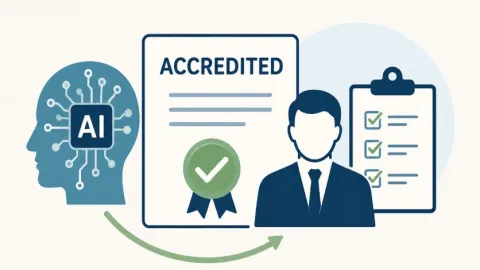
Accredia Opens Accreditation for Certification of AI Professionals
The Italian Accreditation Body (Accredia) has opened accreditation for certification bodies that certify AI professionals under the new UNI 11621-8:2026 standard.
HKAS Sets Transition Plan for ISO/IEC 17020:2026
The Hong Kong Accreditation Service (HKAS) has published its transition schedule for ISO/IEC 17020:2026, giving accredited inspection bodies until March 31, 2029, to comply with the revised international standard for inspection bodies.
NEN Evaluates Online Standards Development Platform for Potential Adoption
The Netherlands Standardization Institute (NEN) is exploring potential adoption of the Online Standards Development (OSD) platform from ISO and IEC.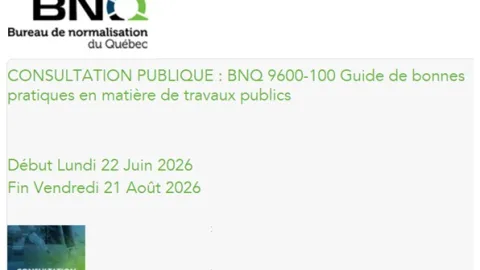
Quebec Opens Consultation on Good Practices Guide for Public Works
The Bureau de normalisation du Québec (BNQ) has opened a public consultation on draft guide BNQ 9600-100, a new good practices guide intended to help Quebec municipalities use more consistent approaches to public works.
Spain Publishes UNE 41610, Europe's First Standard for Industrialized Construction
The Spanish Association for Standardization (UNE) has published UNE 41610, the first technical standard for industrialized construction in Europe.
Bulgaria Holds First Trade Union Standardization Awareness Event
Bulgaria held its first trade union awareness event on standardization on June 12, bringing together trade union representatives to explore how standards contribute to safe and healthy workplaces and how workers can take part in shaping them.
Korea Revises Five Operating Rules for Its Laboratory Accreditation Scheme
The Korean Agency for Technology and Standards (KATS) has revised five operating rules governing the Korea Laboratory Accreditation Scheme (KOLAS) to improve the operation of the national accreditation system and clarify existing requirements.
DAkkS Updates Accreditation Portal With Faster Document Management
The German Accreditation Body (DAkkS) has released a major update to its online accreditation portal, DAkkS-PORT, making it easier for organizations to upload, manage, and submit documents during the accreditation process.Global News

ISO and IEC Form JTC 5 Committee on Digital Product Passport Standards
A new international standards committee has been created to develop standards for digital product passports (DPPs), systems designed to share key product information across the entire lifecycle and improve transparency and circular economy practices.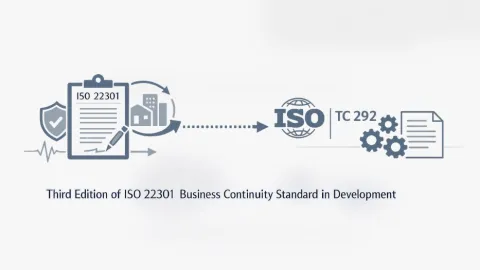
Third Edition of ISO 22301 Business Continuity Standard Enters Development
The next revision of ISO 22301, the international standard for business continuity management systems (BCMS), has moved into development.
Global Accreditation Cooperation Incorporated Launches Website
Global Accreditation Cooperation Incorporated has launched its new official website, providing a central online platform for the organization that became the single global body for international accreditation cooperation.
Cradle to Cradle Certified Version 5 Released With Stronger Focus On Measurable Product Requirements
The Cradle to Cradle Products Innovation Institute (C2CPII) has released Version 5 of the Cradle to Cradle Certified standard,
IEC 63372 Establishes Method For Measuring Carbon Footprint And Avoided Emissions In Electronics
The International Electrotechnical Commission (IEC) has published IEC 63372,
IFAN Launches Podcast Highlighting Perspectives Of Standards Users
The International Federation of Standards Users (IFAN), a global organization representing the interests of standards users, has launched a podcast aimed at sharing the experiences of organizations and professionals who use standards in their work.
ISO 25859 for Thermophilic Microorganisms in Dairy Under Development
The International Organization for Standardization (ISO) is developing ISO 25859, a new international standard that will define how microorganisms that grow at high temperatures are counted in milk and dairy products.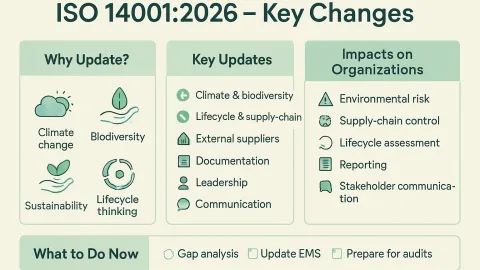
ISO 14001 Final Draft Approved For Publication
The Final Draft International Standard (FDIS) of ISO 14001 has been approved, paving the way for publication in mid April.
IATF Establishes Legal Entity, Ending Ad Hoc Structure
The International Automotive Task Force (IATF) has established a new legal entity, IATF AISBL, marking a shift from its previous structure as an ad hoc group of automotive manufacturers and their national industry associations.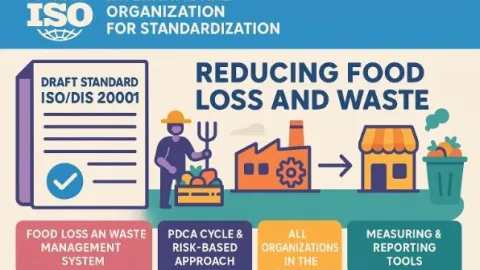
Have Your Say On Food Waste Management: ISO 20001 Survey
Harper Adams University is inviting professionals across the food chain to take part in a survey on ISO 20001, a proposed international management system standard designed to help organisations systematically reduce food loss and waste.
GOTS Version 8.0 Released With Expanded Due Diligence And Environmental Controls
Global Standard has released Version 8.0 of the Global Organic Textile Standard (GOTS),