
Management Systems World
All on Quality and other Standards in one place since 2010. Now Worldwide.
News
Please note that you have to be a registered member with paid membership in order to see full articles.
RegisterSelected News

SCC Launches Accreditation Scheme for Beef Without Growth-Enhancing Products
The Standards Council of Canada (SCC) has launched a new accreditation sub-program for certification bodies verifying Canada's Growth Enhancing Product-free (GEP-free) beef program for exports to the European Union.
'Standard China' Social Media Network Goes Live
China's standardization authorities have launched the "Standard China" social media network to strengthen public communication about standardization and support the implementation of the National Standardization Development Outline.
NEN Begins Preparations for Revision of ISO/IEC 27002
As ISO/IEC 27002 approaches its scheduled five-year review in 2027, the Royal Netherlands Standardization Institute (NEN) has begun preparing the Dutch contribution to the expected revision.
Revised NS 9431 Improves Waste Classification and Data Quality
Standard Norway (SN) has published a revised version of NS 9431 to improve how waste is classified, recorded, and reported across Norway.
NVIDIA Halos AI Systems Inspection Lab Becomes First Accredited Inspection Program for Physical AI Safety
The NVIDIA Halos AI Systems Inspection Lab has become the first accredited inspection program for the safety of physical AI systems after receiving ISO/IEC 17020 accreditation from the ANSI National Accreditation Board (ANAB).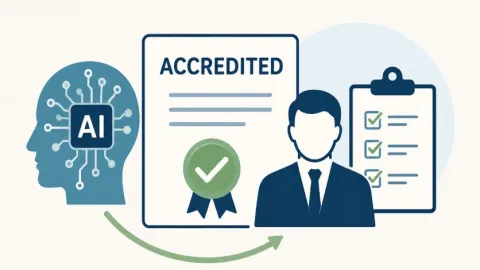
Accredia Opens Accreditation for Certification of AI Professionals
The Italian Accreditation Body (Accredia) has opened accreditation for certification bodies that certify AI professionals under the new UNI 11621-8:2026 standard.
HKAS Sets Transition Plan for ISO/IEC 17020:2026
The Hong Kong Accreditation Service (HKAS) has published its transition schedule for ISO/IEC 17020:2026, giving accredited inspection bodies until March 31, 2029, to comply with the revised international standard for inspection bodies.
NEN Evaluates Online Standards Development Platform for Potential Adoption
The Netherlands Standardization Institute (NEN) is exploring potential adoption of the Online Standards Development (OSD) platform from ISO and IEC.
Quebec Opens Consultation on Good Practices Guide for Public Works
The Bureau de normalisation du Québec (BNQ) has opened a public consultation on draft guide BNQ 9600-100, a new good practices guide intended to help Quebec municipalities use more consistent approaches to public works.
Spain Publishes UNE 41610, Europe's First Standard for Industrialized Construction
The Spanish Association for Standardization (UNE) has published UNE 41610, the first technical standard for industrialized construction in Europe.
Bulgaria Holds First Trade Union Standardization Awareness Event
Bulgaria held its first trade union awareness event on standardization on June 12, bringing together trade union representatives to explore how standards contribute to safe and healthy workplaces and how workers can take part in shaping them.
Korea Revises Five Operating Rules for Its Laboratory Accreditation Scheme
The Korean Agency for Technology and Standards (KATS) has revised five operating rules governing the Korea Laboratory Accreditation Scheme (KOLAS) to improve the operation of the national accreditation system and clarify existing requirements.Global News
IVECO Group Updates Customer Requirements for IATF 16949 Suppliers
IVECO Group has updated its Customer Specific Requirements (CSRs) for organizations certified to IATF 16949, setting new expectations for how suppliers manage quality, testing, sustainability, and supply disruptions.
Public Consultation Opens on Revised FSC Chain of Custody Standards
The Forest Stewardship Council (FSC) has opened a public consultation on the revision of its Chain of Custody standards, with comments accepted until January 25, 2026.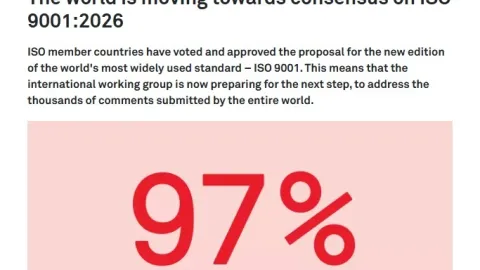
ISO/DIS 9001 Approved with Overwhelming Global Support, Reports SIS
The Swedish Institute for Standards (SIS) reports that ISO member countries have approved the Draft International Standard ISO 9001:2026 with 97 percent voting in favor,
First Global Standard To Measure Pharmaceutical Impact: PAS 2090 Launched
The UK’s national standards body BSI has published the first global standard for measuring the environmental impact of medicines.
GLOBALG.A.P. Recognizes Eight Schemes in 2025 Benchmarking Round
Eight agriculture and floriculture schemes have secured recognized status as GLOBALG.A.P. benchmarked schemes for 2025, giving producers accepted ways to meet market requirements without duplicate audits.
First ISO/IEC 5259-3 Certification for AI Data Quality Management Published
AI Clearing has become the first organization to earn certification under ISO/IEC 5259-3, the new international standard for managing data quality in artificial intelligence (AI) systems.
GFSI Opens Applications and Extends Deadline for BMRs v2024
The Global Food Safety Initiative (GFSI) has opened applications for the Benchmarking Requirements Version 2024 (BMRs v2024), the criteria used to evaluate and recognise food safety certification programmes worldwide.
PEFC Opens Consultation On Revised Project Sourcing Standard
The Programme for the Endorsement of Forest Certification (PEFC) has opened a public consultation on its revised PEFC Project Sourcing standard, which is available for feedback until December 23, 2025.
Circular Design Process Aims to Transform the Global Textile and Fashion Industry
The global textile and fashion industry is under increasing pressure to reduce waste, improve material use, and meet new expectations from regulators and consumers.
Global Payments Shift to ISO 20022 in a Move to Improve Data Quality
Banks worldwide have completed the shift to the ISO 20022 payments standard, following SWIFT’s cutoff of older message formats on November 22.
ISO 10993-1 Update Raises Biological Safety Expectations for Medical Devices
The new ISO 10993-1:2025 from ISO brings substantial changes to how manufacturers plan and justify the biological safety of medical devices.