Management Systems World
All on Quality and other Standards in one place since 2010. Now Worldwide.
News Food / Agriculture
Please note that you have to be a registered member with paid membership in order to see full articles.
RegisterSelected News
Russia Extends Use of 'Eco' and 'Bio' Labels Without Organic Proof Until 2030
Manufacturers in Russia can continue using terms like "eco," "bio," and related labels on their products without needing to prove organic compliance until September 1, 2030.
SGS Introduces Services to Support FSMA 204 Food Traceability Compliance
SGS has launched a set of services to help companies prepare for upcoming food traceability requirements in the United States.
Nelson-Jameson Idaho Distribution Center Earns Perfect Score in First SQF Audit
Nelson-Jameson's distribution center in Jerome, Idaho, has earned a perfect 100% score in its first audit under the Safe Quality Food (SQF) Program, reflecting the highest level of food safety and quality certification.
NATA Publishes Biobanking Guide to Strengthen Trust in Stored Biological Materials
The National Association of Testing Authorities (NATA) has released a new Biobanking Industry Guide to help organizations understand the importance of accreditation in maintaining reliable, high-quality biological materials for long-term research and data use.
Futura Agricola 2015 Winery Claims Four Landmark Food Certifications
Futura Agricola 2015, a young Apulian winery owned by the Vespa Vignaioli group, has achieved four landmark food-related certifications: BRCGS Food Safety, IFS Food, ISO 22005, and SQNPI.
Russia Makes Digital Labeling Mandatory for Spices and Snacks
Digital labeling is now mandatory for all seasonings, spices, and snack products in Russia as of July 1, 2025.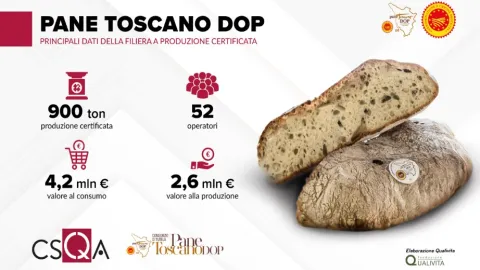
PDO Tuscan Bread has a consumer market value of €4.2 million
CSQA has been reauthorized by Italy’s Ministry of Agriculture, Food Sovereignty and Forests to inspect Pane Toscano DOP (Tuscan Bread with Protected Designation of Origin) for another three years,
GLOBALG.A.P. Compliance Guide Published for U.S. Fruit and Vegetable Farms
A national interpretation guideline has been published to help United States producers meet the requirements of the Integrated Farm Assurance (IFA) v6 GFS standard for fruit and vegetables,
Italy Steps Up Food Fraud Crackdown with Over 54,000 Checks in 2024
Italy’s Central Inspectorate for the Protection of Quality and the Repression of Fraud in Agri-food Products (ICQRF) released its 2024 report,
Africa Sets Up Continental Agency to Harmonize Food Safety Standards
Africa has adopted a statute to create the Africa Food Safety Agency, a major step toward coordinating and harmonizing food safety standards and regulations across the continent.
Front Label Warning Required for Dairy Substitutes in Serbia
Serbia will require all dairy products that use palm oil or other vegetable oils instead of milk fat to display a front-of-pack warning label.
UK Outlines When Mandatory Non-EU Labeling Will Apply
The United Kingdom has outlined how it will implement mandatory "Not for EU" labeling on certain products sold domestically.Global News

IFS Announces June Release of Progress Logistics Version 2
IFS will publish IFS Progress Logistics version 2 at the end of June, updating the program that helps companies prepare for IFS Logistics certification.
Third Cohort of Environmental Management Youth Leadership Group Kicks Off
The third cohort of the ISO Environmental Management (ISO/TC 207) Youth Leadership Group (YLG 3.0) has held its kick-off meeting, bringing together more than 45 participants from around 30 countries.
ISO 9606 Requirements for Welder Qualification Under Revision
The International Organization for Standardization (ISO) is revising ISO 9606, the international standard for qualification testing of welders performing fusion welding.
ISO 9001 Auditing Practices Group Releases First AI-Focused Guidance
The ISO 9001 Auditing Practices Group (APG) has published new guidance on auditing quality management systems that use artificial intelligence, marking the group's first publication dedicated specifically to AI.
ISO 10993-6 Standard for Implantation Testing Updated
The International Organization for Standardization (ISO) has published a revised edition of ISO 10993-6, expanding guidance for implantation studies used in the biological evaluation of medical devices.
All 12 Recognized Food Safety Program Owners Apply for GFSI Version 2024 Recognition
The Consumer Goods Forum's Global Food Safety Initiative (GFSI) has confirmed that all 12 previously recognized Certification Program Owners (CPOs) have applied for recognition against the GFSI Benchmarking Requirements Version 2024.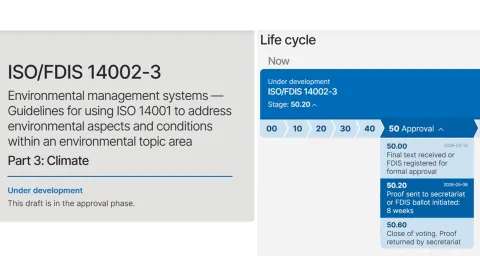
ISO 14002-3 Climate Guidance Advances to Final Draft Stage
ISO 14002-3, a guidance standard for managing climate-related issues within ISO 14001 environmental management systems, has advanced to the Final Draft International Standard (FDIS) stage.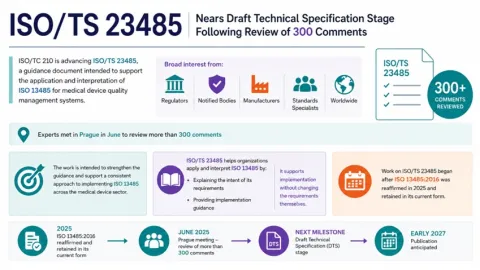
ISO/TS 23485 Nears Draft Technical Specification Stage Following Review of 300 Comments
The International Organization for Standardization's (ISO) Technical Committee 210 (ISO/TC 210) is advancing work on ISO/TS 23485,
Global ACI Explains Which IAF and ILAC Documents Remain in Force During Transition
The Global Accreditation Cooperation Incorporated (Global ACI) has published a cross-reference tableshowing the status of former International Accreditation Forum (IAF) and International Laboratory Accreditation Cooperation (ILAC) publications.
Standards Behind the FIFA World Cup 2026
As the FIFA World Cup 2026 gets underway across the United States, Canada and Mexico,
CEN and CENELEC Open Nominations for 2026 Standards+Innovation Awards
The 2026 Standards+Innovation Awards are now accepting nominations for individuals and projects that have contributed to standardization through research, innovation and education.