Management Systems World
All on Quality and other Standards in one place since 2010. Now Worldwide.
News
Please note that you have to be a registered member with paid membership in order to see full articles.
RegisterSelected News
DANAK Updates Asset Management Accreditation Guidance
The Danish Accreditation Fund (DANAK) has revised AMC 42, its guidance on accreditation scopes for asset management certification bodies.
India Introduces New Vegan Food Logo Requirements
India has introduced a new official logo for vegan food products, with updated labeling requirements taking effect on July 1, 2027.
KATS Opens Applications for 11 Standards Development Projects
The Korean Agency for Technology and Standards (KATS) has opened applications for 11 government-funded projects aimed at strengthening South Korea's role in international standards development across a range of emerging technology sectors.
Norway Takes the Helm of European Feed Analysis Standards Secretariat
Standard Norway (SN) has taken over the secretariat of a European Committee for Standardization (CEN) committee responsible for feed sampling and analysis,
UNE Magazine Issue 92 Celebrates 40 Years of Spanish Standardization
The Spanish Association for Standardization (UNE) has published the latest edition of UNE Magazine.
BRCGS Seeks Nominations for 2026 Americas Awards
Nominations are now open for the BRCGS Awards 2026 Americas, which recognize individuals and organizations that support BRCGS certification and contribute to food and product safety across the region.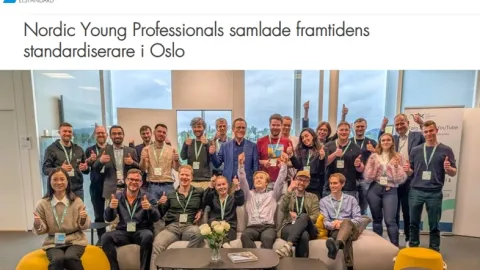
Oslo Event Connects Future Experts in Electrotechnical Standardization From Across the Nordics
The Nordic Electrotechnical Standardization Bodies (NOREK) brought together young professionals from Norway, Sweden, Denmark and Finland in Oslo on June 3–4 for Nordic Young Professionals 2026.
UKAS Begins Development of ISO 14067 Product Carbon Footprint Accreditation
The United Kingdom Accreditation Service (UKAS) has begun work toward a new accreditation program for organizations that validate and verify product carbon footprints under ISO 14067:2018.
Digital Identification and Product Passports Lecture Opens 'Standards Made Easy' Series
The Croatian Standards Institute (HZN) and the Croatian Engineering Association (HIS) have launched the 'Standards Made Easy' lecture series, opening with an online session on digital identification and digital product passports.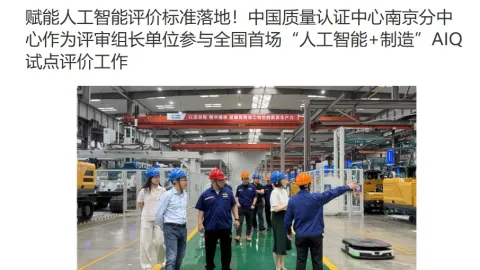
First Pilot Completed Under China's New AI Manufacturing Evaluation Framework
The first pilot evaluation under China's newly implemented Artificial Intelligence + Manufacturing (AIQ) assessment scheme has been completed,
GET-UNE 29 Launched to Develop Strategic Industrial Autonomy Standard
The Spanish Association for Standardization (UNE) and Spain’s Ministry of Industry and Tourism (MINTUR) have launched GET-UNE 29,
Singapore Proposes ISO/IEC 42119-8 Standard for Generative AI Testing
The Infocomm Media Development Authority (IMDA) and Enterprise Singapore (EnterpriseSG) have proposed ISO/IEC 42119-8, a new international standard for testing generative artificial intelligence (AI) systems.Global News
ISO 18295 Revision: Modern Communication Trends Reshape Customer Contact Standards
The International Organization for Standardization (ISO) has launched a revision of its two customer contact standards, ISO 18295-1 and ISO 18295-2, to reflect current communication practices and the growing role of artificial intelligence in customer interactions.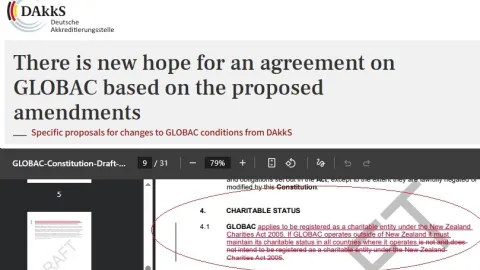
DAkkS Proposes GLOBAC Fix: No Conflicts of Interest, No Profit Motive
The German Accreditation Body (DAkkS) has proposed legal changes to GLOBAC that would allow EU national accreditation bodies to join without violating European law.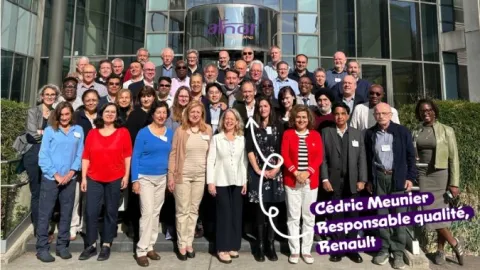
France and Norway to Lead Committee in Charge of ISO 9000 Family of Standards
The French Standardization Association (AFNOR) and Standard Norway (SN) will jointly lead ISO/TC 176, Quality management and quality assurance, the ISO technical committee responsible for the ISO 9000 family of quality management standards.
Second Consultation Round Begins for Global Organic Textile Standard Version 8.0
The second public consultation for Version 8.0 of the Global Organic Textile Standard (GOTS) is now open and will run until August 15, 2025.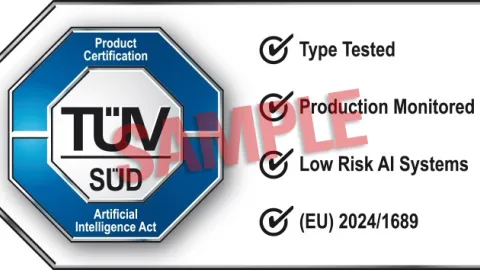
TÜV Süd Launches Voluntary Test Mark for Low-Risk AI Systems
TÜV Süd has launched a voluntary certification mark for low-risk AI (artificial intelligence) systems, allowing manufacturers to prove the quality of their AI solutions even when no legal requirements apply.
Draft of ISO 17024 for Certification of Persons Wins Overwhelming Approval
The draft of ISO/IEC 17024, a conformity assessment standard for certifying persons, has been approved by ISO, IEC, and CEN.
New ISO Agreement Proposed to Align Global Greenhouse Gas Accounting Rules
A new ISO International Workshop Agreement (IWA) has been proposed to harmonize greenhouse gas (GHG) accounting standards for industrial products and improve the comparability of emissions data across global supply chains.
Two New Papers Map AI and Multimedia Authenticity Standards
The AI and Multimedia Authenticity Standards Collaboration (AMAS) released two major papers on July 11 at the AI for Good Global Summit in Geneva.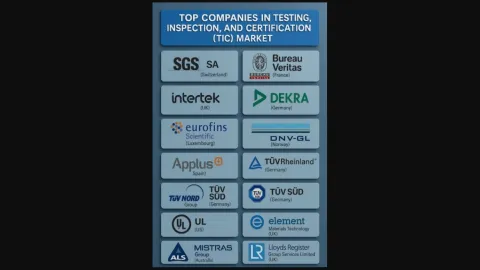
TIC Market Expected to Reach USD 282.76 Billion by 2030
The global testing, inspection, and certification (TIC) market is projected to grow from USD 239.48 billion in 2025 to USD 282.76 billion by 2030, with a compound annual growth rate of 3.4%, according to a new report by MarketsandMarkets.
Public Comments Open on Draft Revision of ISO 20252 Market Research Standard
A revised draft of ISO 20252—covering vocabulary and service requirements for market, opinion and social research—is under international review, with ISO member bodies invited to submit feedback by September 4.
SQF Edition 10 Coming in August With Focus on Culture, Risk, and Monitoring
The Safe Quality Food Institute (SQFI), the organization behind the SQF Program, will publish Edition 10 of its code in August 2025.