Management Systems World
All on Quality and other Standards in one place since 2010. Now Worldwide.
News Asia
Please note that you have to be a registered member with paid membership in order to see full articles.
RegisterSelected News
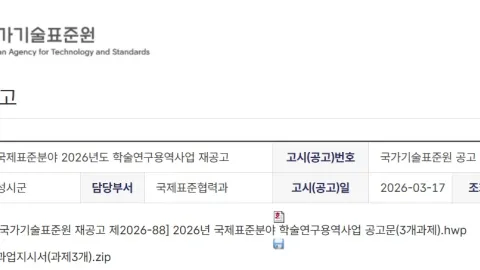
South Korea Opens Call For International Standards Research Projects In 2026
The Korean Agency for Technology and Standards (KATS) has opened a call for 2026 research projects focused on international standardization, inviting institutions and experts to submit proposals by March 30.
Education Standards In Focus In March Edition Of Manak Samachar
The Bureau of Indian Standards (BIS) has released the March 2026 edition of its monthly magazine Manak Samachar,
SASO First In Saudi Arabia To Secure ISO 42001 AI Management Certification
The Saudi Standards, Metrology and Quality Organization (SASO) has become the first organization in Saudi Arabia to achieve ISO/IEC 42001 certification for its artificial intelligence management system (AIMS),
GSO Proposes Updated Halal Food Requirements
The Gulf Cooperation Council Standardization Organization (GSO) has released a draft of GSO 2055-1:2026, setting general requirements for Halal food across all stages of the food supply chain.
CNAS Warns Against Misuse Of Accreditation Mark
The China National Accreditation Service for Conformity Assessment (CNAS) has issued a public statement warning against the misuse of its accreditation mark, identifying a specific case and calling for immediate corrective action.
BIS Highlights Gold Purity And Hallmarking In Standards Watch Episode 30
The Bureau of Indian Standards (BIS) has released episode 30 of its Standards Watch series, focusing on how gold purity is verified in today’s market.
Taiwan Steel Union Achieves UL 2809 Certification For Recycled Content Validation
Taiwan Steel Union (TSU) has obtained certification to the UL 2809 standard, confirming the recycled content in its crude zinc oxide product through third-party validation.
China Seeks Organizations To Host ISO Compliance And Starch Subcommittees And Build Mirror Bodies
The Standard Innovation Department of the State Administration for Market Regulation (SAMR) has launched a call for organizations to apply to host two ISO subcommittees and to take part in several newly established technical bodies.
Korea Opens Applications For 2026 World Standards Day Awards
The Korean Agency for Technology and Standards (KATS) has issued guidelines and opened applications for the 2026 World Standards Day government awards,
Türkiye Issues First PEFC Chain Of Custody Accreditation
The Turkish Accreditation Agency (TÜRKAK) has granted its first accreditation under the PEFC ST 2002:2020 Chain of Custody standard, enabling certification activities in Türkiye to be carried out in line with international requirements.
QUACERT Hosts Free Halal Standards Training For Businesses In Vietnam
The Vietnam Certification Center (QUACERT) will host a free in-person training course on April 1, 2026, in Hanoi, to help organizations understand key Halal standards and access requirements for Halal markets.
Students Wanted For Korean Team: International Standards Olympiad Applications Open
South Korea has opened applications to select its national student team for the 21st International Standards Olympiad,Global News
ISO 9002 Revision Moves To Draft International Standard Stage
The revision of ISO 9002 has entered the Draft International Standard (DIS) stage, with ISO/TC 176/SC 2, the ISO subcommittee responsible for quality systems, advancing the project into formal consultation.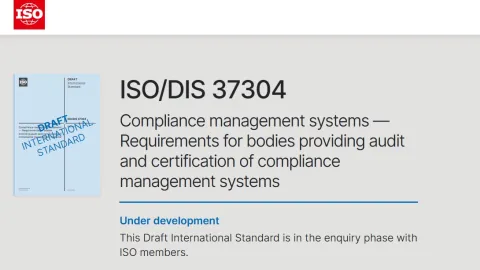
ISO 37304 Compliance Management Certification Standard Advances to Final Draft Stage
The International Organization for Standardization (ISO) has advanced ISO 37304 to the final draft international standard (FDIS) stage.
One Vote Tips Toward New Edition Of ISO/IEC 17065 Over Amendment
One vote has tipped the decision toward publishing a new edition of ISO/IEC 17065 instead of issuing a separate amendment, following a closely split ballot within the International Organization for Standardization (ISO).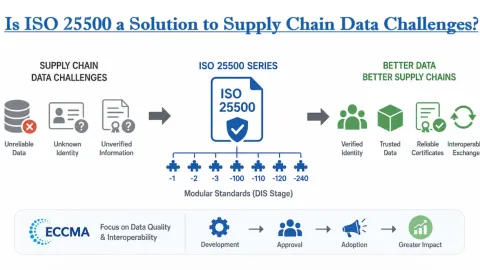
Is ISO 25500 a Solution to Supply Chain Data Challenges?
ISO 25500, a draft series of standards from the International Organization for Standardization (ISO), is presented by the Electronic Commerce Code Management Association (ECCMA) as a possible way to address long-standing problems with unreliable data across global supply chains.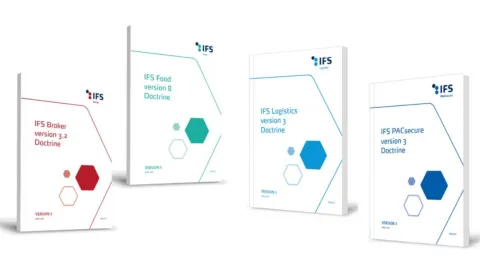
IFS Updates Food, Logistics, Broker And Pacsecure Doctrines To Clarify Certification Rules
The International Featured Standards (IFS) has published updated doctrine documents for its current standards covering food production, logistics, brokerage, and packaging materials, clarifying how certification requirements should be applied without revising the standards themselves.
PAS 25535 on Sustainability in Asset Management Reaches Draft Stage
PAS 25535, a specification focused on integrating sustainability into asset management systems, has reached the committee draft stage within the International Organization for Standardization (ISO), marking the close of its initial comment period.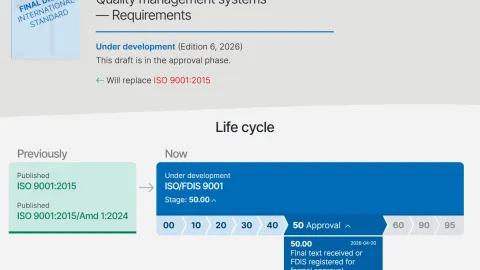
ISO 9001 Revision Moves to FDIS Stage as Early Analysis Questions Scope of Changes
The International Organization for Standardization (ISO) has confirmed that the revision of ISO 9001 has entered the Final Draft International Standard (FDIS) stage, marking the last step before publication.
DIN to Lead ISO IEC Joint Technical Committee 5 on Digital Product Passport Standards
Following an initiative by the German Institute for Standardization (DIN) and the German Commission for Electrical, Electronic & Information Technologies (DKE),
ANSI/TIA-942 Addendum Targets AI Data Center Cooling and High-Density Needs
The Telecommunications Industry Association (TIA) is developing a new addendum to the ANSI/TIA-942 data center standard to address the growing demands of artificial intelligence (AI) infrastructure.
IATF Introduces Mandatory Auditor Training for Corporate Scheme Audits
The International Automotive Task Force (IATF) has approved a new mandatory training module to strengthen how auditors assess organizations certified under corporate audit schemes for IATF 16949.
ISO/TS 19384 Sets First Standard for Digital Service Excellence
The International Organization for Standardization (ISO) has released ISO/TS 19384:2026,