Management Systems World
All on Quality and other Standards in one place since 2010. Now Worldwide.
News
Please note that you have to be a registered member with paid membership in order to see full articles.
RegisterSelected News
Sweden’s First Preparedness Standard SS 22306 Enters Final Stage
The Swedish Standards Institute (SIS) is finalizing SS 22306, Sweden’s first preparedness standard for helping organizations continue operating during wartime or the threat of war.
TÜV AUSTRIA Opens New Branch in Moldova
TÜV AUSTRIA, an independent Austrian testing, inspection and certification provider, has opened a new branch in Chișinău, expanding its services in the Republic of Moldova.
JSA Opens Call for Cross-Industry Standardization Topics
The Japan Standards Association (JSA) has opened a call for topics for study groups in 2027 that will look at standardization issues affecting several industries or technical fields.
Czech Standards Agency Forms Council to Help Shape AI Testing Framework
The Czech Standards Agency (ČAS) has formed a Market and Innovation Council to involve the private sector in preparing a regulatory sandbox under the European Union’s Artificial Intelligence Act (EU AI Act).
FDA Issues 2026 Food Code With New Requirements for Retail Food Safety
The U.S. Food and Drug Administration (FDA) has issued the 2026 Food Code, updating its model requirements for food safety in restaurants, retail stores and other food service operations.
CYS to Present ISO 9001:2026 at World Standards Day Event
The Cyprus Organisation for Standardisation (CYS) has adopted the new edition of ISO 9001 and announced an open World Standards Day event where it will present CYS EN ISO 9001:2026.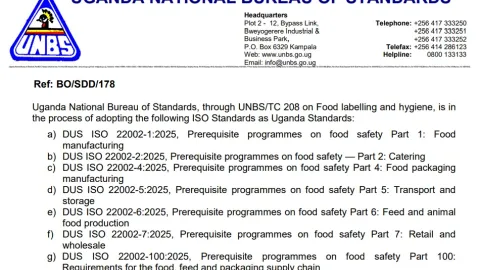
Uganda Moves to Adopt Seven ISO 22002:2025 Standards for Food Safety Prerequisite Programs
The Uganda National Bureau of Standards (UNBS) has opened a public consultation on adopting seven standards from the ISO 22002:2025 series as Uganda Standards.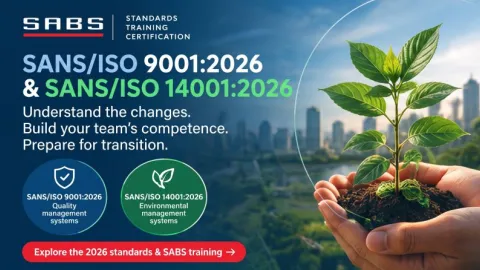
South Africa Issues Identical National Adoption of ISO 9001:2026
The South African Bureau of Standards (SABS) has published SANS/ISO 9001:2026, making the new ISO 9001 edition available as a South African National Standard.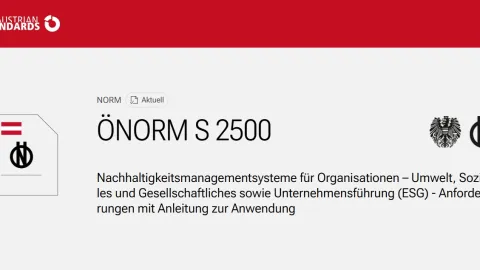
Austria Moves Sustainability Certification to New ÖNORM S 2500 With Broader ESG Focus
Austria’s new ÖNORM S 2500:2026 sustainability management standard took effect on August 1, replacing ONR 192500:2011.
ABNT Project Helps 11 Small Businesses Gain Ecolabel Certification
The Brazilian Association of Technical Standards (ABNT) has completed a project that helped 11 micro and small businesses obtain the ABNT Ecolabel,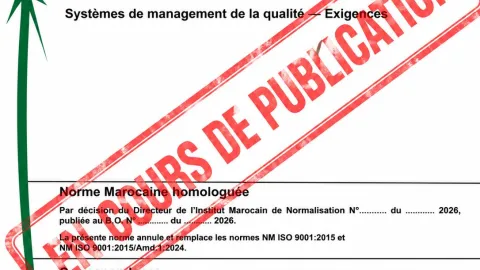
Morocco Adopts ISO 9001:2026 Ahead of National Publication
The Moroccan Institute for Standardization (IMANOR) has adopted ISO 9001:2026 as the Moroccan standard NM ISO 9001:2026, which is now awaiting official publication.
ANAB Establishes Scholarship for Emerging Quality and Conformity Assessment Professionals
The ANSI National Accreditation Board (ANAB) has launched a new scholarship for students preparing for careers in quality, safety, accreditation, conformity assessment, laboratory sciences, credentialing and standards development.Global News
Global ACI Sets Three-Year Transition Timelines for ISO 14001:2026 and ISO 9001:2026
Global Accreditation Cooperation Incorporated (Global ACI) has set three-year transition periods for accredited certification to ISO 14001:2026 and ISO 9001:2026, ending September 30, 2029 and April 30, 2029, respectively.
China Approves World’s First Medical Device Standard for AI Brain-Computer Interfaces
China has approved YY/T 2029-2026, the world’s first medical device standard for brain-computer interfaces (BCIs) that use artificial intelligence (AI).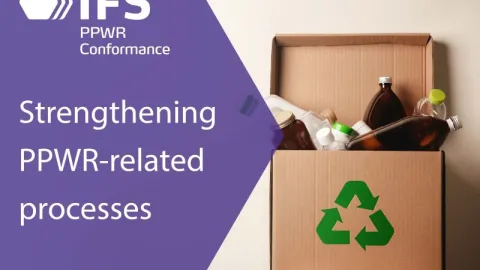
IFS Makes EU Packaging Rules Self-Assessment Tool Available After 70-Company Pilot
International Featured Standards (IFS) has made its self-assessment tool for the EU Packaging and Packaging Waste Regulation (PPWR) available in the IFS Database after a pilot involving 70 companies.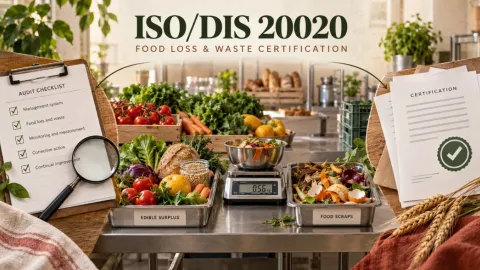
Comment Open on ISO/DIS 20020 for Bodies Auditing and Certifying Food Loss and Waste Management Systems
Comments are open on ISO/DIS 20020, a draft standard setting requirements for bodies that audit and certify food loss and waste management systems (FLWMS).
ISO Begins Developing IWA 52 to Harmonize Transport GHG Emission Factors
The International Organization for Standardization (ISO) is developing IWA 52 to harmonize how greenhouse gas (GHG) emission factors are calculated for transport.
ISO 22095-1 Chain of Custody Revision Reaches Committee Draft Stage
ISO 22095-1 has reached the Committee Draft stage, moving the revision of the general chain of custody framework into formal consultation.
IATF Clarifies Complaint Handling for Certification Bodies
The International Automotive Task Force (IATF) has issued new guidance for certification bodies on handling vehicle manufacturer performance complaints through the IATF Complaint Management System (IATF CMS).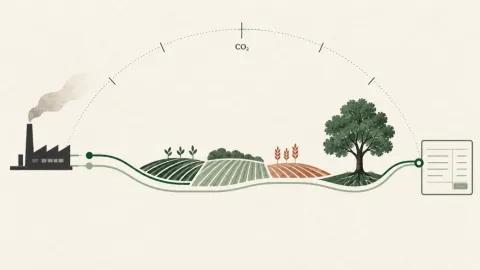
How SBTi and GHG Protocol Updates Expand Options for Corporate Emissions Accounting
Changes from the Science Based Targets initiative (SBTi) and Greenhouse Gas Protocol, two major frameworks for corporate climate targets and greenhouse-gas accounting, are expanding the options companies have for addressing and accounting for value-chain emissions.
ISO 9001:2026 Officially Launched
The sixth edition of ISO 9001, the world’s most widely used quality management system standard, has been officially launched by ISO during a virtual press conference.
Global Responsible Textile Standard (GRTS) Launches for Certification of Wider Range of Fibers
Global Standards has launched the Global Responsible Textile Standard (GRTS), a new certification standard for textiles made from a wider range of plant, animal, synthetic, man-made cellulosic and recycled fibers.
ISO 45001 Second Edition Clears DIS Ballot With Overwhelming Support
The draft second edition of ISO 45001 has passed its Draft International Standard (DIS) vote with only one vote against, moving the revision closer to its planned publication in the first half of 2027.