Management Systems World
All on Quality and other Standards in one place since 2010. Now Worldwide.
News Medical Products & Pharmaceuticals
Please note that you have to be a registered member with paid membership in order to see full articles.
RegisterSelected News
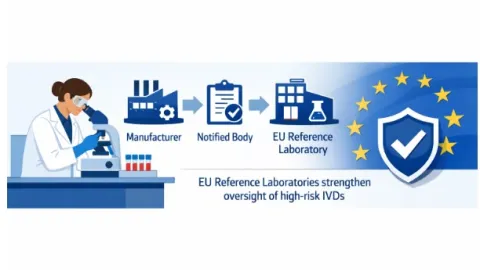
EU Expands Laboratory Oversight for Highest Risk In Vitro Diagnostic Devices
The European Union (EU) has expanded oversight of Class D in vitro diagnostic medical devices under Regulation (EU) 2017/746, known as the In Vitro Diagnostic Regulation (IVDR).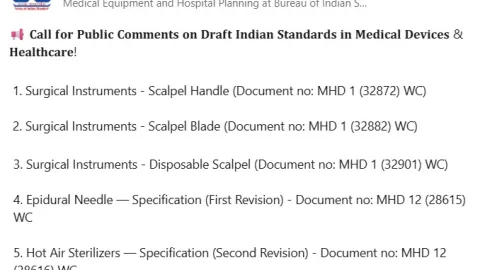
BIS Seeks Public Feedback on Draft Standards for Medical Devices and Healthcare
The Bureau of Indian Standards (BIS), through its Medical Equipment and Hospital Planning Department,
FDA Aligns U.S. Device Rules With ISO 13485, Replaces QSR With QMSR
The U.S. Food and Drug Administration (FDA) has replaced its long-standing Quality System Regulation (QSR) with the new Quality Management System Regulation (QMSR), changing the legal framework for quality management in the U.S. medical device sector.
NEN Seeks Experts for Clinical Research Standards Committee
The Netherlands Standardization Institute (NEN) is inviting experts to join its Clinical Research standards committee to help shape international standards for clinical investigations of medical devices.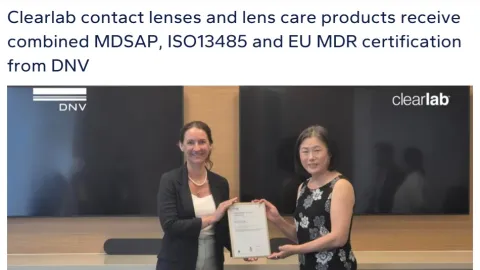
Clearlab Earns MDSAP, ISO 13485 and EU MDR Certifications for Contact Lenses
Clearlab, a manufacturer of vision correction products and lens care solutions, has obtained combined certification under the Medical Device Single Audit Program (MDSAP), ISO 13485, and the European Union Medical Device Regulation (EU MDR).
EU Medical Device Database EUDAMED Opens First Mandatory Modules
The European Commission has published the first four functional modules of EUDAMED, the EU database for medical devices and in vitro diagnostic devices.
IEI Secures TFDA QMS Approval and ISO 13485 Certification
IEI Integration Corp, a Taiwan-based provider of medical and industrial computing systems,
NEN Sets Initial Scope For New Guideline On Sustainable Medical Devices
The Netherlands Standardization Institute (NEN) has set the initial scope for developing a new Dutch Practice Guideline (NPR) on sustainability in medical devices.
Mexico Recognizes MDSAP as Equivalent to National Medical Device GMP
Mexico has issued a new interpretation rule for the NOM-241-SSA1-2025 standard on good manufacturing practices (GMP) for medical devices, confirming that
Dutch In Vitro Standards Committee Presents Broad Agenda for New Laboratory Standards
The Dutch In Vitro Diagnostics Standards Committee is driving a wide range of international work on new laboratory and diagnostic standards, reflecting the rapid rise of digital tools, artificial intelligence, and smarter testing systems.
Standard Norway to Establish National Committee on Medical Device Standards
Standard Norway (SN) is creating a new national mirror committee, SN/K 113, to contribute to international standardization on quality management for medical devices.
Sweden Moves to Standardize Medicine Dispenser APIs
Sweden has launched work on a national standard for Application Programming Interfaces (APIs) used in automated medicine dispensers.Global News

ISO Begins Developing IWA 52 to Harmonize Transport GHG Emission Factors
The International Organization for Standardization (ISO) is developing IWA 52 to harmonize how greenhouse gas (GHG) emission factors are calculated for transport.
ISO 22095-1 Chain of Custody Revision Reaches Committee Draft Stage
ISO 22095-1 has reached the Committee Draft stage, moving the revision of the general chain of custody framework into formal consultation.
IATF Clarifies Complaint Handling for Certification Bodies
The International Automotive Task Force (IATF) has issued new guidance for certification bodies on handling vehicle manufacturer performance complaints through the IATF Complaint Management System (IATF CMS).
How SBTi and GHG Protocol Updates Expand Options for Corporate Emissions Accounting
Changes from the Science Based Targets initiative (SBTi) and Greenhouse Gas Protocol, two major frameworks for corporate climate targets and greenhouse-gas accounting, are expanding the options companies have for addressing and accounting for value-chain emissions.
ISO 9001:2026 Officially Launched
The sixth edition of ISO 9001, the world’s most widely used quality management system standard, has been officially launched by ISO during a virtual press conference.
Global Responsible Textile Standard (GRTS) Launches for Certification of Wider Range of Fibers
Global Standards has launched the Global Responsible Textile Standard (GRTS), a new certification standard for textiles made from a wider range of plant, animal, synthetic, man-made cellulosic and recycled fibers.
ISO 45001 Second Edition Clears DIS Ballot With Overwhelming Support
The draft second edition of ISO 45001 has passed its Draft International Standard (DIS) vote with only one vote against, moving the revision closer to its planned publication in the first half of 2027.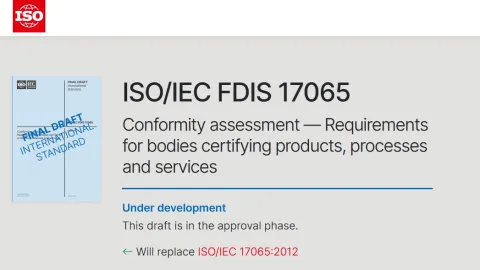
Second Edition of ISO/IEC 17065 Reaches Final Approval Phase
The second edition of ISO/IEC 17065, which sets requirements for bodies that certify products, processes and services, has moved further into the final approval process and is now at stage 50.20 of the Final Draft International Standard (FDIS) phase.
SMART Initiative Enters Pilot Phase in October, Testing Nine Standards
A pilot of the ISO and IEC SMART standards initiative will begin in October, testing nine selected international standards.
New Net Zero Carbon Cities Standard Project Approved as ISO 37115-2
The International Organization for Standardization (ISO) has approved a proposal for ISO 37115-2, a new standard that will set out principles and fundamentals for net zero carbon cities.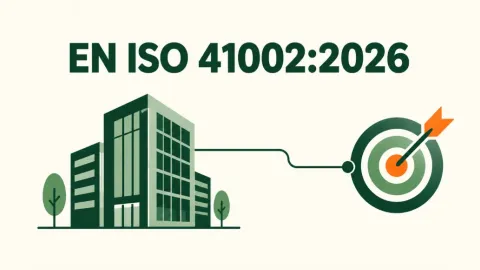
First Edition of ISO 41002 Guides Development of Facility Management Organizations
The first edition of ISO 41002 gives organizations guidance on how to develop and structure their facility management function across strategic, tactical and operational levels.