Management Systems World
All on Quality and other Standards in one place since 2010. Now Worldwide.
News
Please note that you have to be a registered member with paid membership in order to see full articles.
RegisterSelected News

RvA Updates Prisma Reporting Tool for Assessment Reporting
The Dutch Accreditation Council (RvA) has launched an updated version of its Prisma Reporting Tool, introducing changes to how assessment findings, deviations, and reports are structured and presented.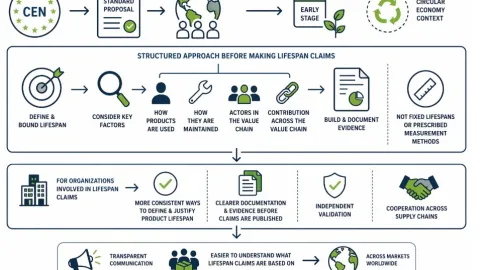
European Standard Proposal Aims to Clarify Product Lifespan Claims
The European Committee for Standardization (CEN) is considering a new standard that would help organizations worldwide better justify and communicate how long their products are expected to last.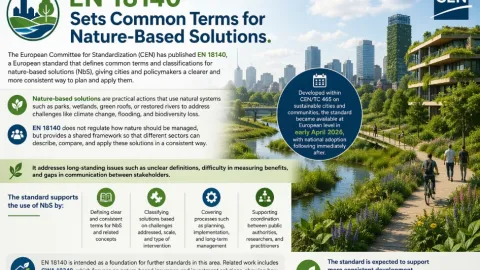
EN 18140 Sets Common Terms for Nature-Based Solutions
The European Committee for Standardization (CEN) has published EN 18140, a European standard that defines common terms and classifications for nature-based solutions (NbS),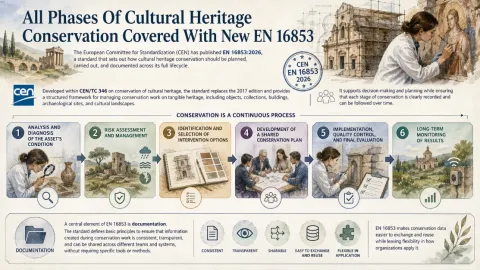
All Phases Of Cultural Heritage Conservation Covered With New EN 16853
The European Committee for Standardization (CEN) has published EN 16853:2026,
EN 15978 Harmonizes Building Environmental Performance Assessment
The European Committee for Standardization (CEN) has published EN 15978:2026,
ANAB Launches QAEP to Evaluate Credibility and Effectiveness of Quality Assurance Schemes
The ANSI National Accreditation Board (ANAB) has launched the Quality Assurance Evaluation Program (QAEP),
Inacal Raises Alert Over ‘Rapid ISO Certification’ Claims
The Instituto Nacional de Calidad (INACAL) warned companies and public institutions about offers of “rapid ISO certifications” and urged them to check whether certification bodies are properly accredited before using their services.
China Issues New Guide For Public Institution Carbon Accounting
A new industry standard for carbon accounting in public institutions took effect on April 1, marking a step toward more consistent measurement and management of emissions across China’s public sector.
Vietnam Seeks Input On Plan To Build Standard Workforce Through 2030
The Ministry of Science and Technology (MST) has opened consultation on a draft national plan to train and develop the workforce in standardization, metrology, and quality through 2030 and beyond.
KAB Updates Accreditation Rules to Add Sustainability Certification and Revise Privacy Scheme
The Korea Accreditation Board (KAB) has updated its accreditation manual, introducing a new sustainability certification scheme and revising how privacy certification is structured, alongside changes to how certification bodies are assessed.
Call for Participation in Cybersecurity, Privacy, and Emerging Technology Standards Opens in India
A new call for participation in developing standards for cybersecurity, privacy, and emerging technologies has been launched by the Bureau of Indian Standards (BIS) and the Data Security Council of India (DSCI), a nonprofit industry body focused on data protection and cybersecurity.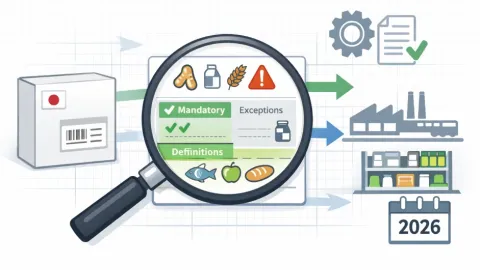
Japan Updates Food Labeling Rules for Allergen Information
The Consumer Affairs Agency (CAA) has revised Japan’s Food Labeling Standards to update allergen information and improve how key safety details are presented on food products.Global News
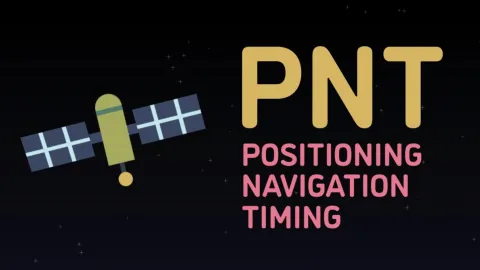
Launch of Global Standards Consultation on PNT (Positioning, Navigation, and Timing)
The International Organization for Standardization (ISO) is inviting experts worldwide to participate in an open consultation on Positioning, Navigation, and Timing (PNT) services.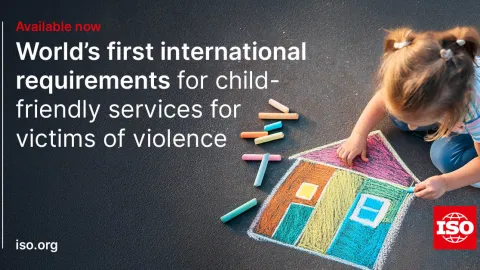
First Global Standard for Child-Friendly Services for Victims of Violence Released by ISO
In a historic move, the International Organization for Standardization (ISO) has introduced WA 49:2025, the first international guidelines for child-friendly services aimed at supporting victims of violence.
ISO Develops Two Standards for eDNA Analysis in Aquatic Life Research
ISO is developing two international standards to improve the reliability of environmental DNA (eDNA) techniques used to study aquatic life and assess water quality.
Renault Group Updates Quality Requirements for IATF 16949
Renault Group has updated its Customer-Specific Requirements (CSRs) for IATF 16949:2016, effective March 14, 2025.
BRCGS Invites Experts to Join Technical Working Group for Consumer Products Issue 5
BRCGS is calling for industry professionals to join its Technical Working Group (TWG) to help revise the Consumer Products Standard, currently at Issue 4, which was launched in 2016.
FSSC 22000 Certification Body Applications Paused Due to High Demand
The Foundation FSSC has announced a 12-month pause on new applications from Certification Bodies (CBs) for the FSSC 22000 Scheme, effective from March 14, 2025, to March 14, 2026.
UNECE Recommendations Aim to Enhance Conformity Data Exchange and Product Transparency
The United Nations Economic Commission for Europe (UNECE) has released two significant documents that could shape global trade and sustainability frameworks.
ISO 37001 Updated to Strengthen Anti-Bribery Efforts Worldwide
The International Organization for Standardization (ISO) has released ISO 37001:2025, an updated anti-bribery management system standard aimed at strengthening integrity, ethical leadership, and governance in organizations worldwide.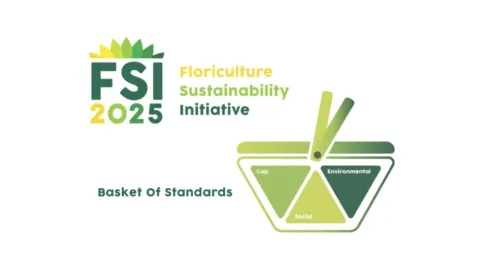
GLOBALG.A.P. to Meet All Three Pillars of FSI "Basket of Standards" for Flowers Soon
In 2025, GLOBALG.A.P. will align its solutions with all three pillars of the Floriculture Sustainability Initiative's (FSI) "Basket of Standards", enhancing responsible sourcing in the floriculture sector.
ISO 27028 Expected in 2025: New Framework for Tailoring Security Attributes
ISO is currently developing ISO 27028, a guideline on attributes aligned with ISO/IEC 27002:2022.
FSSC Launches Resource Library for Social Sustainability Consultants
Foundation FSSC has launched the FSSC 24000 Consultants Resource Library to support consultants specializing in the social component of Environmental, Social, and Governance (ESG) management.