Management Systems World
All on Quality and other Standards in one place since 2010. Now Worldwide.
News Food / Agriculture
Please note that you have to be a registered member with paid membership in order to see full articles.
RegisterSelected News
FDA Plans Big Change to Food Safety Oversight by Shifting Inspections to States
The U.S. Food and Drug Administration (FDA) is planning to transfer most routine food safety inspections to state-level agencies, a move that could reshape how food safety is monitored across the country.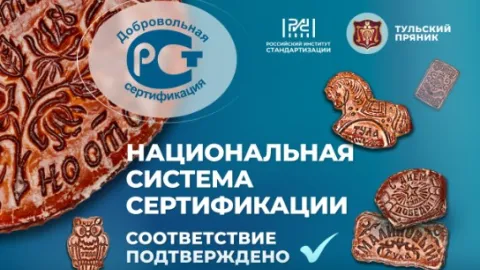
Tula Gingerbread Earns National Certification for Quality Standards
The famous Tula gingerbread, known locally as Tula pryanik, has been officially certified under Russia’s National Certification System, confirming it meets national quality standards.
Argentina Updates Food Code, Including Precise Rules for Traditional Balsamic Vinegar
Argentina has introduced three updates to its Food Code through joint resolutions published in the Official Gazette.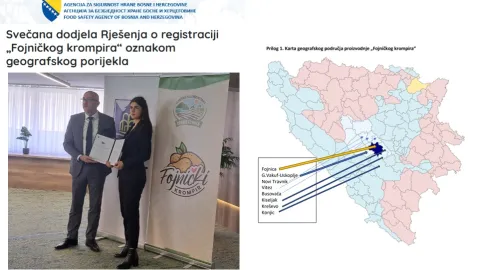
Fojnica Potato Gains Protected Status for Geographic Origin
The Fojnica Potato has officially been registered with a geographic indication, confirming its identity and market value.
Smart Upgrade for Sicily’s Pistacchio di Raffadali Geographical Label of Origin
The Pistacchio di Raffadali DOP, a product with a geographical label of origin from a famous growing area in Sicily, is rolling out a mandatory Digital Passport and updated Control Plan for all producers starting next harvest season.
Ukraine Issues Organic Food Labeling Requirements
Ukraine’s State Service for Food Safety and Consumer Protection (SSUFSCP) has introduced new labeling rules for domestically produced organic food.
China Updates National Rules for Labeling Prepackaged Food
China has issued a revised version of its national standard GB 7718–2025 for labeling prepackaged food, which will take effect on March 16, 2027, following a two-year transition period.
Authentic Honey Guaranteed Under New Italian Standard Using Nuclear Magnetic Resonance
A new Italian standard aims to expose food fraud in honey by identifying added sugars using advanced technology.
GLOBALG.A.P. Releases Version 2.1 of Add-On for U.S. Produce Safety Compliance
The latest version of the GLOBALG.A.P. FSMA Produce Safety Rule (PSR) add-on, version 2.1, was published on January 7, 2025, and will replace version 2.0 for all audits starting April 7, 2025.
Honey Testing Halted in Serbia as Beekeepers Claim Deliberate Obstruction
The analysis of honey quality and safety in Serbia has been halted for over a month, according to the Union of Beekeeping Organizations of Serbia (SPOS),
Croatia Promotes Voluntary Food Labels to Support Domestic Agriculture and Guide Consumers
Croatia’s Agriculture and Food Agency (HAPIH) oversees a voluntary labeling system for agricultural and food products aimed at strengthening domestic production.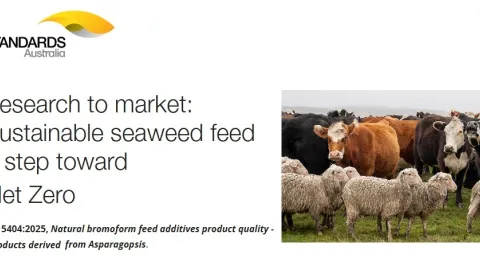
World-First Seaweed Feed Standard Drives Australia Toward Net Zero
Australia has released a world-first standard for seaweed-based livestock feed, aiming to reduce methane emissions and support Net Zero goals.Global News
FSC Opens Consultation on Chain of Custody Revisions as Two Core Standards Reach Final Phase
The Forest Stewardship Council (FSC) has opened consultation on revisions to five Chain of Custody (CoC) documents, with two core standards now entering the final consultation phase.
CanadaGAP Seeks GFSI Recognition for Updated Food Safety Programs
The Global Food Safety Initiative (GFSI) has opened a public stakeholder consultation as CanadaGAP seeks recognition for updated food safety certification programs covering fruit and vegetable operations.
Efforts to Broaden Application of ISO 21378 Underway
Following last year’s confirmation of ISO 21378:2019, a standard for structured audit data collection and exchange, work within ISO/TC 295/WG 1 is now focused on broadening how the standard is applied across organizations.
ISO 14019-3 Working Draft Reviewed Ahead of October Stage Decision
The development of ISO 14019-3, a proposed international standard on sustainability information validation processes,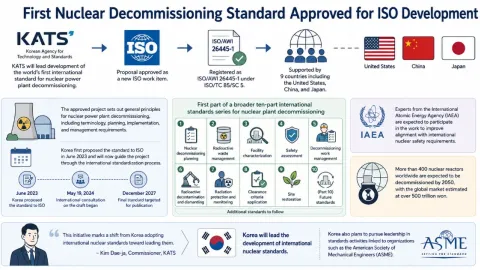
First Nuclear Decommissioning Standard Approved for ISO Development
The Korean Agency for Technology and Standards (KATS) will lead development of the world’s first international standard for nuclear power plant decommissioning after its proposal was approved as a new ISO work item.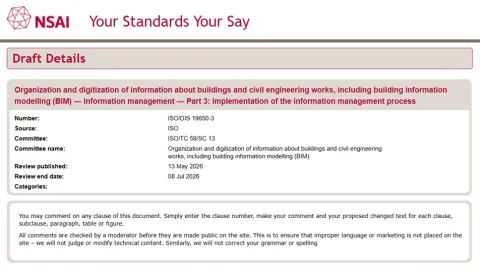
Public Consultation Opens for Revised ISO 19650-3 BIM Standard
A public consultation has opened for the revised draft of ISO 19650-3, the part of the ISO 19650 series focused on information management during the operational phase of built assets.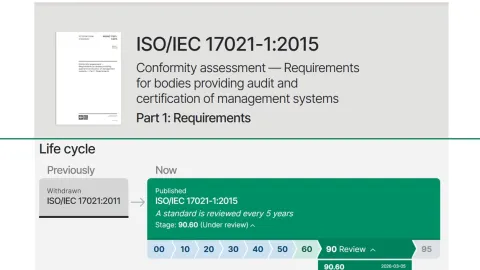
ISO/IEC 17021-1 Confirmation Keeps Certification Rules Stable
The International Organization for Standardization’s (ISO) Committee on Conformity Assessment (ISO/CASCO) has confirmed continuation of the current edition of ISO/IEC 17021-1,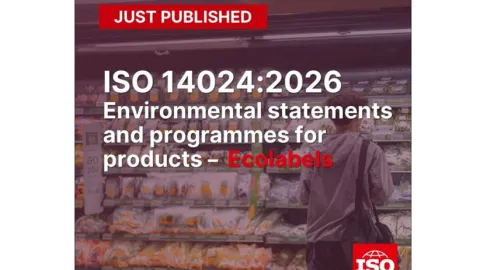
Revised ISO 14024 Aims to Prevent Greenwashing in Ecolabel Programs
The International Organization for Standardization (ISO) has published the third edition of ISO 14024, revising requirements for ecolabel certification programs to improve verification of environmental claims and help prevent greenwashing,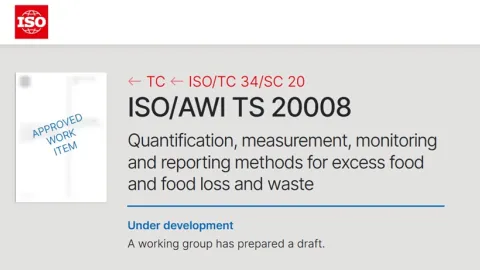
Experts Sought for ISO TS 20008 Food Waste Measurement and Reporting Project
The International Organization for Standardization (ISO) has started development of ISO/AWI TS 20008,
Joint ISO and IEC Team Releases Information Model for SMART Content
The International Organization for Standardization (ISO) and the International Electrotechnical Commission (IEC) have released the first version of the IEC & ISO Information Model for SMART content,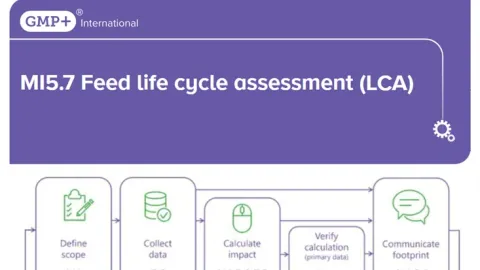
GMP+ International Launches Feed Life Cycle Assessment Standard
The GMP+ International has launched the MI5.7 Feed Life Cycle Assessment LCA standard, introducing a harmonized method for calculating and communicating the environmental impact of feed products across the supply chain.