Management Systems World
All on Quality and other Standards in one place since 2010. Now Worldwide.
News Germany
Please note that you have to be a registered member with paid membership in order to see full articles.
RegisterSelected News
SKZ Warns About Fake Certificates For Plastic Products
SKZ - German Plastics Center has warned about fake SKZ certificates for plastic products appearing in the market.
UKAS and DAkkS Publish Joint Guidance on AI in Accredited Conformity Assessment
The United Kingdom Accreditation Service (UKAS) and the German accreditation body (DAkkS) have published joint guidance to help conformity assessment bodies adopt artificial intelligence (AI) responsibly in accredited activities.
Quality Austria and ÖVQ Announce Finalists for DACH Quality Awards 2026
Quality Austria and the Austrian Association for Quality Assurance (ÖVQ) have announced the finalists for the 2026 Quality Awards, recognizing leading professionals, young talents, and teams across the DACH region (Germany, Austria, and Switzerland).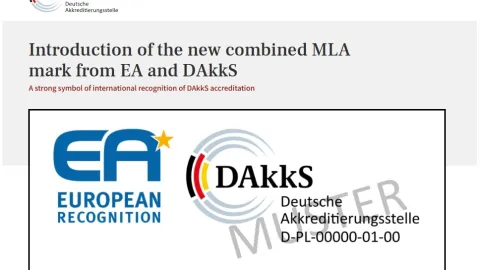
How DAkkS Applies the EA MLA Mark in Germany
The German accreditation body (DAkkS) can now offer a combined accreditation symbol together with the European co-operation for Accreditation (EA), based on the EA Multilateral Agreement (MLA) mark published on September 1, 2025.
MISSION AI Presents Quality Standard for Low-Risk AI
A new voluntary quality standard for low-risk artificial intelligence has been launched by the partners of MISSION AI,
German Industry Groups Present Broad Reform Plan for National Accreditation
A wide alliance of German industry associations, laboratory organizations, and sectoral trade bodies has presented a future strategy to improve the national accreditation system, calling for simpler procedures, clearer responsibilities, and faster decisions.
Germany Releases First Safety Standard for Plug-In Solar Devices
The German Commission for Electrical, Electronic & Information Technologies (DKE) will publish the world’s first product standard for plug-in solar devices in December 2025, giving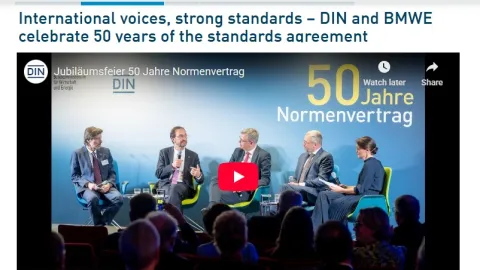
Germany Marks 50 Years of the National Standards Agreement
The German Institute for Standardization (DIN) and the Federal Ministry for Economic Affairs and Climate Action (BMWE) celebrated the 50th anniversary of the Standards Agreement on November 6 at DIN’s headquarters in Berlin.
German Labs Group Welcomes Proposed Accreditation Reform Strategy, Calls for Clearer Plan
The Association of Independent Testing Laboratories (VUP) welcomed the German Industry Federation’s (BDI) proposal to reform Germany’s accreditation system but said the plan still lacks a clear reform roadmap.
DIN, DQS and DGQ Join Forces to Guide Professionals Through ISO 9001 Transition
The revision of ISO 9001 and its German version is scheduled for publication in fall 2026, introducing updates expected to reflect evolving quality management practices.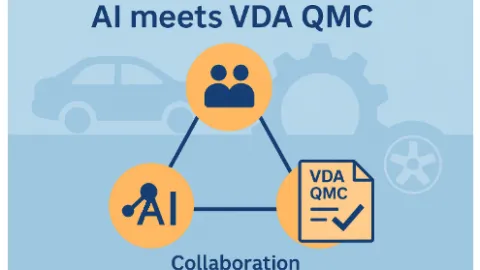
VDA QMC Project Group Presents AI Framework for Quality Management
The Quality Management Center of the German Association of the Automotive Industry (VDA QMC) is developing a new VDA Volume on the use of artificial intelligence in quality management.
Germany’s Leading Standards Bodies Urge Integration of Technical Rules into Modernization Agenda
Germany’s three leading standardization organizationsGlobal News
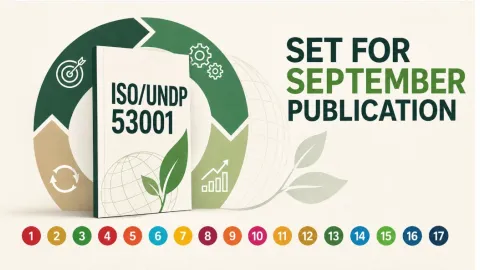
Upcoming ISO/UNDP 53001 Sets First Management System Requirements for the SDGs
ISO/UNDP 53001, set for publication in September 2026, will provide the first management system requirements specifically for organizations seeking to manage and improve their contribution to the Sustainable Development Goals (SDGs).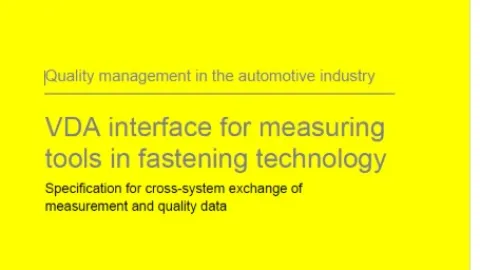
VDA Releases VDA 5.4 Draft for Fastening Measurement Tools
The Quality Management Center of the German Association of the Automotive Industry (VDA QMC) has released VDA 5.4, Interface for measuring tools in fastening technology, as a Yellow Volume for industry feedback.
ISO/CASCO Clarifies: ISO/IEC 17025 Does Not Require Labs to Treat Accreditation Bodies as Suppliers
The maintenance group of the International Organization for Standardization’s Committee on Conformity Assessment (ISO/CASCO) has clarified that ISO/IEC 17025:2017 does not require laboratories to treat their accreditation bodies as external service providers subject to the standard’s supplier controls.
JFS-C Standard Version 3.2 Gains GFSI Recognition Under 2024 Benchmarking Requirements
The Global Food Safety Initiative (GFSI) has recognized JFS-C Standard Version 3.2 from the Japan Food Safety Management Association (JFSM) against its 2024 Benchmarking Requirements.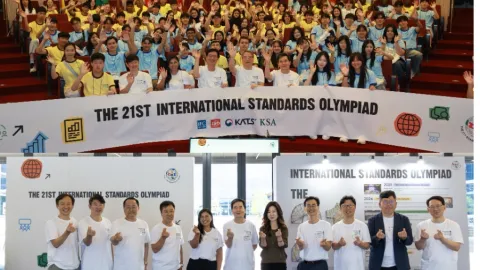
21st International Standards Olympiad Held in Korea
The 21st International Standards Olympiad brought together 105 middle-and high-school students from 11 countries in the Republic of Korea for a three-day competition and hands-on experience with international standardization.
ISO Environmental Management Committee Seeks Global Input for 2027-30 Plan
The International Organization for Standardization (ISO) Technical Committee 207 (ISO/TC 207), Environmental management, has launched a global consultation to help set its priorities for 2027-30.
DIS Ballot for ISO 30401 Knowledge Management Revision Closes September 17
ISO 30401, the international standard for knowledge management systems, is currently at the Draft International Standard (DIS) stage, with voting on the proposed second edition due to close September 17, 2026.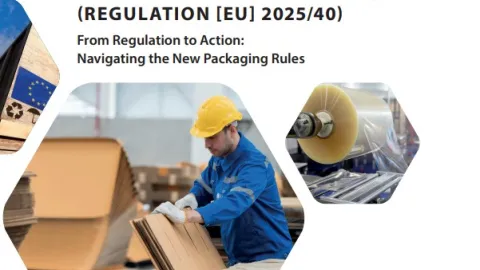
IFS Publishes PPWR White Paper and Launches Self-Assessment as EU Rules Take Effect
International Featured Standards (IFS) has published a new PPWR white paper and launched a self-assessment tool as the first requirements of the European Union’s Packaging and Packaging Waste Regulation (PPWR) took effect on August 12, 2026.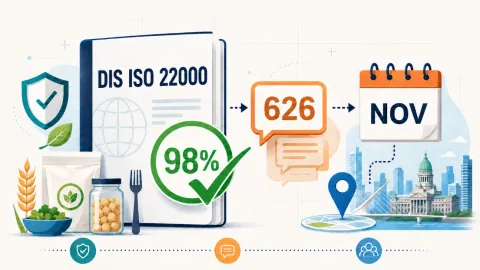
ISO 22000 Draft Approved With 98% Support, Comments Review Set for November
The revision of ISO 22000, the international standard for food safety management systems, has cleared its Draft International Standard (DIS) ballot with 98% positive votes.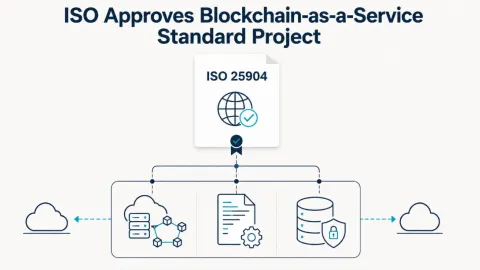
ISO Approves Blockchain-as-a-Service Standard Project
The International Organization for Standardization (ISO) has approved ISO 25904, a new standard project to establish a common technical framework and functional requirements for Blockchain-as-a-Service (BaaS) platforms.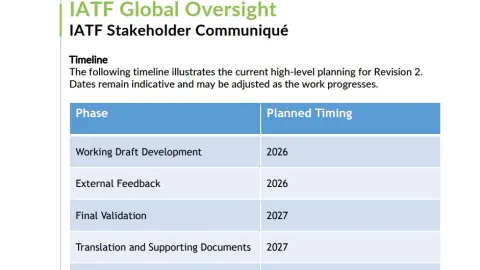
IATF 16949 Second Edition Expected in Mid-2027 With Five Priorities Set
IATF 16949 is expected to reach its second edition in mid-2027, with five priorities set for the revision.