Management Systems World
All on Quality and other Standards in one place since 2010. Now Worldwide.
News Europe
Please note that you have to be a registered member with paid membership in order to see full articles.
RegisterSelected News
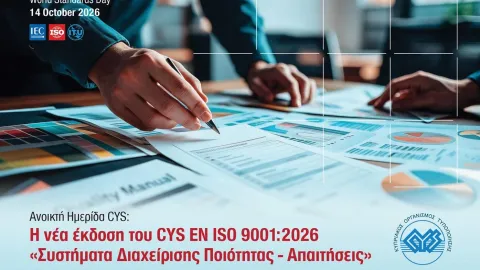
CYS to Present ISO 9001:2026 at World Standards Day Event
The Cyprus Organisation for Standardisation (CYS) has adopted the new edition of ISO 9001 and announced an open World Standards Day event where it will present CYS EN ISO 9001:2026.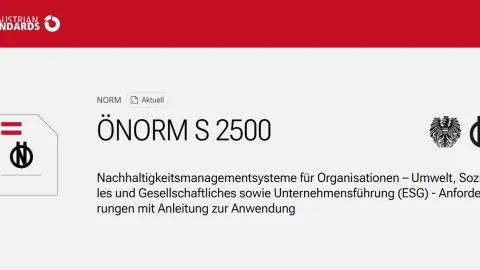
Austria Moves Sustainability Certification to New ÖNORM S 2500 With Broader ESG Focus
Austria’s new ÖNORM S 2500:2026 sustainability management standard took effect on August 1, replacing ONR 192500:2011.
DAkkS Shortens Accreditation Procedures for Calibration Laboratories
The German Accreditation Body (DAkkS) is introducing new application forms and reference scopes for calibration laboratories to shorten accreditation procedures and reduce costs and administrative work.
Norway Moves to Establish National Biotechnology Standards Committee
Standard Norway and Tekna, a Norwegian professional association for scientists and technologists, are taking steps to establish a national biotechnology standards committee.
Forbici Nursery Gets Italy’s First Native Plant/Biodiversity Certification
CSQA has issued Italy’s first certification under the Native Plant/Biodiversity (Pianta Nativa/Biodiversità) standard to Forbici Agricultural Company’s Forest Plant Nursery in Desenzano del Garda.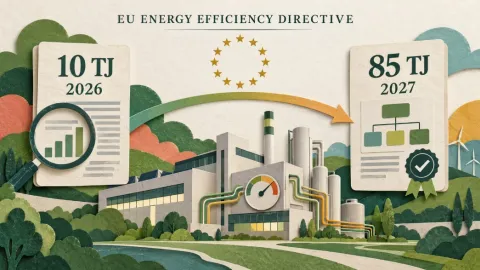
EU Energy Efficiency Directive Sets New Energy Management, Certification and Audit Requirements
The European Union’s (EU) Energy Efficiency Directive 2023/1791 introduces new energy-management, independent certification and energy-audit requirements for companies, with key deadlines in 2026 and 2027.
Library Standards Take Focus in BDS Compass Issue 3/2026
The Bulgarian Institute for Standardization (BDS) has devoted the latest issue of BDS Compass to the standards behind library services, from identifying publications to measuring performance and preserving collections.
AI and Data Center Energy Demand Lead September PKN News
Artificial intelligence (AI) and the growing electricity demand from data centers lead the September issue of Wiadomości PKN (PKN News) from the Polish Committee for Standardization (PKN).
UNI’s STANDARD Magazine Returns With Coverage of Demographic Change and New ISO 9001
The September 2026 issue of STANDARD, the magazine of the Italian Standards Body (UNI),
European MOZART Project Develops CWA 18409:2026 for Grasp-Free Robotic Food Handling
CWA 18409:2026 has been published by the European Committee for Standardization (CEN), providing a common technical framework for grasp-free robotic systems designed to move and manipulate soft, fragile and irregular food products using deformable surfaces instead of conventional grippers.
ISBIH Glasnik 2/26 Covers Hot Topics From Household Robots to the Mostar Fair
The Institute for Standardization of Bosnia and Herzegovina (ISBIH) has published the second 2026 issue of its Glasnik newsletter, covering recent standards developments alongside the Institute’s work in Bosnia and Herzegovina and across the region.
Eighth HZN e-Glasilo of 2026 Covers Cloud Security, AI and European Standards
The Croatian Standards Institute (HZN) has published the eighth issue of its e-Glasilo newsletter in 2026, bringing together new Croatian standards and developments from ISO, IEC, CEN and CENELEC, and ETSI.Global News
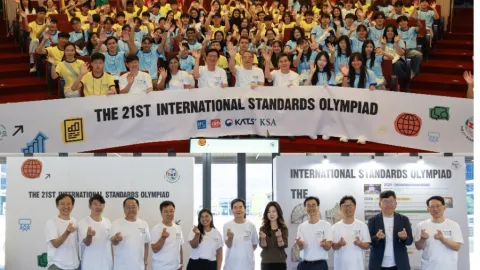
21st International Standards Olympiad Held in Korea
The 21st International Standards Olympiad brought together 105 middle-and high-school students from 11 countries in the Republic of Korea for a three-day competition and hands-on experience with international standardization.
ISO Environmental Management Committee Seeks Global Input for 2027-30 Plan
The International Organization for Standardization (ISO) Technical Committee 207 (ISO/TC 207), Environmental management, has launched a global consultation to help set its priorities for 2027-30.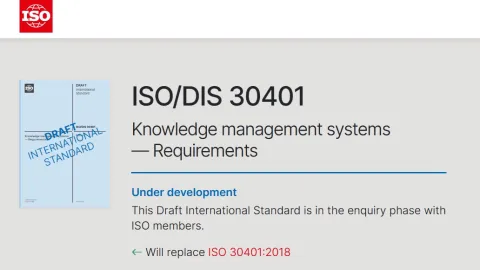
DIS Ballot for ISO 30401 Knowledge Management Revision Closes September 17
ISO 30401, the international standard for knowledge management systems, is currently at the Draft International Standard (DIS) stage, with voting on the proposed second edition due to close September 17, 2026.
IFS Publishes PPWR White Paper and Launches Self-Assessment as EU Rules Take Effect
International Featured Standards (IFS) has published a new PPWR white paper and launched a self-assessment tool as the first requirements of the European Union’s Packaging and Packaging Waste Regulation (PPWR) took effect on August 12, 2026.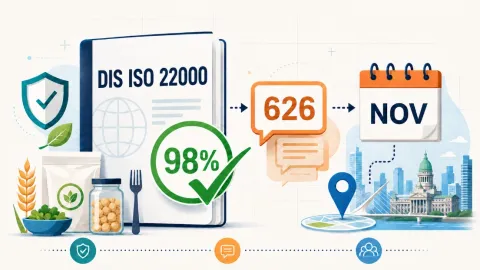
ISO 22000 Draft Approved With 98% Support, Comments Review Set for November
The revision of ISO 22000, the international standard for food safety management systems, has cleared its Draft International Standard (DIS) ballot with 98% positive votes.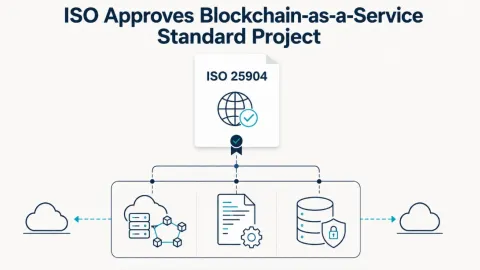
ISO Approves Blockchain-as-a-Service Standard Project
The International Organization for Standardization (ISO) has approved ISO 25904, a new standard project to establish a common technical framework and functional requirements for Blockchain-as-a-Service (BaaS) platforms.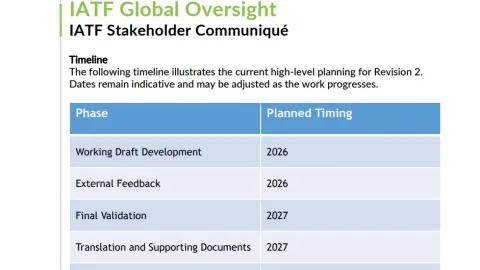
IATF 16949 Second Edition Expected in Mid-2027 With Five Priorities Set
IATF 16949 is expected to reach its second edition in mid-2027, with five priorities set for the revision.
GHG Protocol Aligns Scope 2 and AMI Development for Future Joint ISO Standard
The Greenhouse Gas Protocol (GHG Protocol) the results of its public consultation on the update to its Scope 2 Guidance and released preliminary feedback on the development of its Actions and Market Instruments (AMI) standard.
Risk Management Guidance for AI-Powered Medical Devices: First Edition of ISO/TS 24971-2 Released
ISO has released the first edition of ISO/TS 24971-2:2026, providing guidance on applying the ISO 14971 risk management process to machine learning-enabled medical devices (MLMDs).
Revised ISO 19008 Expands Cost Coding System to Lower Carbon Energy
ISO 19008 has been revised to extend its common system for organizing and comparing cost data to lower carbon energy as well as oil and gas.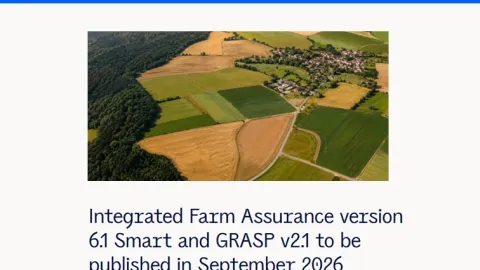
GLOBALG.A.P. Farm Assurance and Social Practice Standards Set for September Update
Agraya has announced that it will publish GLOBALG.A.P. Integrated Farm Assurance (IFA) v6.1 Smart and GLOBALG.A.P. Risk Assessment on Social Practice (GRASP) v2.1 on September 1, 2026.