Management Systems World
All on Quality and other Standards in one place since 2010. Now Worldwide.
News South America
Please note that you have to be a registered member with paid membership in order to see full articles.
RegisterSelected News
Brazil Confirms Quality Strategy Implementation with Official Resolutions
Brazil has formally enacted its National Quality Infrastructure Strategy (ENIQ) and the 2025–2026 Action Plan through Resolutions No. 1 and No. 2 of 2025, published in the Official Gazette on July 1.
Brazil Opens Consultation to Update Product Certification Requirements
Brazil’s National Institute of Metrology, Quality and Technology (Inmetro) has launched a public consultation to revise the country’s general rules for product certification.
Inmetro Puts Digital Verification in the Palm of Your Hand
The Brazilian government has officially launched Inmetro na Palma da Mão (“Inmetro in the Palm of Your Hand”), a new digital verification platform that allows consumers to confirm whether certified products are genuine.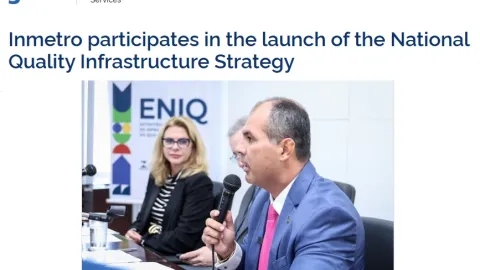
Brazil Unveils First National Quality Strategy Action Plan for 2025–2026
Brazil has launched its National Quality Infrastructure Strategy (ENIQ) and the first related Action Plan, which will be in effect for the 2025–2026 period.
Nominations Now Open for the BRCGS Awards 2025 in the Americas Region
Nominations are now open for the BRCGS Awards 2025, which will be presented at BRCGS Connect Charlotte 2025 this September in North Carolina.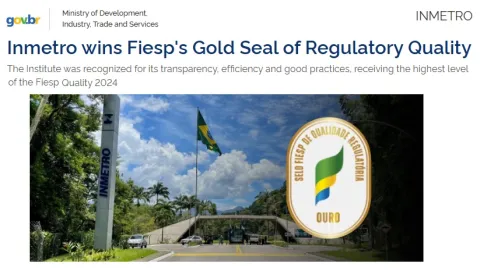
Inmetro Earns Top Fiesp Regulatory Quality Seal from São Paulo Industry Federation
The National Institute of Metrology, Quality, and Technology (Inmetro) has received the 2024 Gold Category of the Regulatory Quality Seal from the Federation of Industries of the State of São Paulo (Fiesp)—
IRAM Marks 90 Years of Advancing Quality and Safety in Argentina
The Argentine Institute of Standardization and Certification (IRAM) celebrated its 90th anniversary on May 2, highlighting nearly a century of work supporting quality, safety, and sustainability in Argentina and beyond.
Federal Prosecutors in Brazil Recognized with Top Certification for Gender Violence Prevention
The Brazilian Association of Technical Standards (ABNT) has awarded the National Council of the Public Prosecutor’s Office (CNMP) the highest category of the “Nós Por Elas” Seal, recognizing its efforts to prevent and combat violence against women.
Public Labs Across Brazil Can Now Join Inmetro’s ProdIQ Accreditation Program
Public institutions throughout Brazil can now voluntarily join the ProdIQ Program, which promotes the accreditation of testing and calibration laboratories and supports professional training.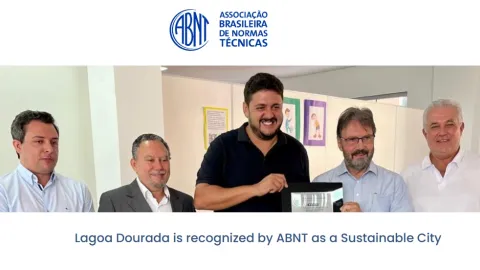
Lagoa Dourada Recognized as Sustainable City by ABNT
Lagoa Dourada, a municipality of about 12,000 people in Minas Gerais, has been officially recognized as a Sustainable City by the Brazilian Association of Technical Standards (ABNT).
Argentina Updates Food Code, Including Precise Rules for Traditional Balsamic Vinegar
Argentina has introduced three updates to its Food Code through joint resolutions published in the Official Gazette.
Brazil Publishes Key Standard to Manage Climate Change Risks
ABNT has published a new national standard to help organizations assess and respond to climate-related risks.Global News
IAQG Centralizes Aerospace Auditor Authentication
The International Aerospace Quality Group (IAQG) has centralized the authentication of aerospace quality management system auditors, replacing the previous network of independent Auditor Authentication Bodies (AABs).
FSC Revised Trademark Standard Takes Effect
The Forest Stewardship Council (FSC) has launched a new online training course to support implementation of its revised trademark standard, FSC-STD-50-001 V3-0, which takes effect on July 1, 2026.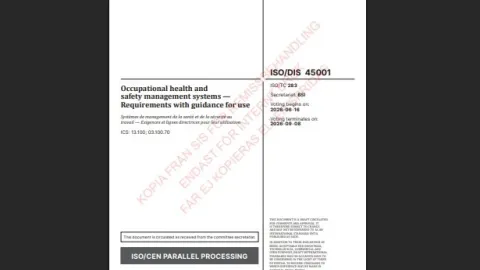
SIS Offers Free Access to ISO 45001 Draft
The Swedish Institute for Standards (SIS) has made the proposed second edition of ISO 45001 - draft available for free download and public review,
ISO/DIS 9002 Ballot Opens for Comment
The International Organization for Standardization (ISO) has released ISO/DIS 9002 for ballot, opening the international comment period on the revision of the guidance standard for applying ISO 9001.
Public Consultation Opens on ISO 14060, First International Standard for Net Zero Alignment
ISO 14060, the first international standard for net zero alignment, has entered public consultation.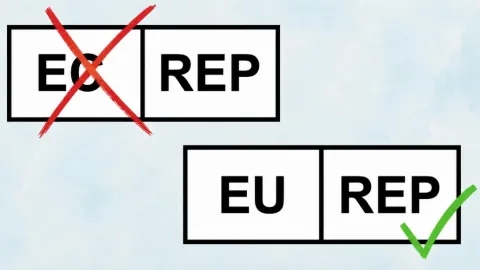
EU Approves EN ISO 15223-1 for Medical Device and IVD Labeling
The European Commission (EC) has approved EN ISO 15223-1, the standard used for symbols on medical device and in vitro diagnostic (IVD) labeling, for use in demonstrating compliance with EU requirements for these products.
GFSI Seeks Feedback on JFSM Recognition Under Benchmarking Requirements v2024
The Global Food Safety Initiative (GFSI) has opened a public stakeholder consultation on the Japan Food Safety Management Association (JFSM) application for recognition under GFSI Benchmarking Requirements Version 2024.
Chery Added as IATF's Third Asian Automotive Group Member
The International Automotive Task Force (IATF) has approved the addition of Chery Automobile, as a new member of IATF AISBL, making it the third Asian automotive group represented in the organization.
IFS Announces June Release of Progress Logistics Version 2
IFS will publish IFS Progress Logistics version 2 at the end of June, updating the program that helps companies prepare for IFS Logistics certification.
Third Cohort of Environmental Management Youth Leadership Group Kicks Off
The third cohort of the ISO Environmental Management (ISO/TC 207) Youth Leadership Group (YLG 3.0) has held its kick-off meeting, bringing together more than 45 participants from around 30 countries.
ISO 9606 Requirements for Welder Qualification Under Revision
The International Organization for Standardization (ISO) is revising ISO 9606, the international standard for qualification testing of welders performing fusion welding.