Management Systems World
All on Quality and other Standards in one place since 2010. Now Worldwide.
News
Please note that you have to be a registered member with paid membership in order to see full articles.
RegisterSelected News
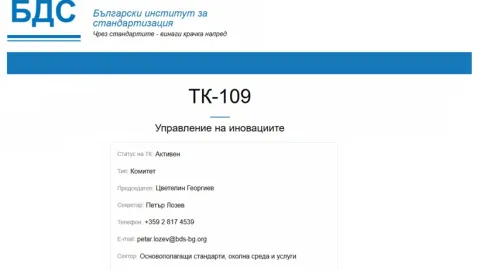
Bulgaria Establishes Innovation Management Standards Committee
The Bulgarian Institute for Standardization (BDS) has established BDS/TC 109, a technical committee dedicated to innovation management standards, replacing an expert working group that had operated in the field since 2011.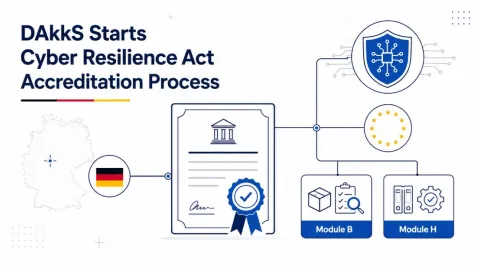
DAkkS Starts Cyber Resilience Act Accreditation Process
Germany’s national accreditation body, Deutsche Akkreditierungsstelle (DAkkS), has opened accreditation applications for conformity assessment bodies that want to work under the EU Cyber Resilience Act (CRA).
Vietnam Expands NQI Database for Standards Searches and Online Procedures
Vietnam is expanding its national database for standards, metrology and quality (NQI) with online tools for businesses and the public, while local authorities are already using the platform to manage data.
Erasmus MC Receives Netherlands’ First Biobank Accreditation
The Dutch Accreditation Council (RvA) has granted the Netherlands’ first biobank accreditation to Erasmus MC Central Biobank & Trialsupport.
NIST Opens AI Documentation Draft for Public Comment
The National Institute of Standards and Technology (NIST) is seeking public comment through September 16 on proposed guidance and templates for documenting AI datasets and models, which it plans to put forward for possible development as an international standard.
South Korea to Lead New ISO Drone Cybersecurity Working Group
South Korea will lead a newly established International Organization for Standardization (ISO) working group on drone cybersecurity, which will oversee the development of international standards in the field.
Czech Republic Adds Construction-Stage Requirements to BIM Data Standard
The Czech Standardization Agency (ČAS) has added construction-stage requirements to the country’s Construction Data Standard (DSS), specifying what information digital building models used in Building Information Modeling (BIM) must contain while a project is being built.
TÜV AUSTRIA Expands Railway Safety and Quality Services with Berlin Company
TÜV AUSTRIA has established TÜV AUSTRIA RAIL GMBH in Berlin, expanding its safety, testing and quality services for railway vehicles and infrastructure.
OECD Confirms Slovakia’s Good Laboratory Practice System Meets Requirements
The Organisation for Economic Co-operation and Development (OECD) has confirmed that Slovakia’s Good Laboratory Practice (GLP) monitoring system continues to meet its requirements, allowing qualifying study data from Slovak test facilities to remain internationally accepted.
Portugal Opens Nominations for 2026 Standardization Merit Award
The Portuguese Institute for Quality (IPQ) has opened nominations for its 2026 Standardization Merit Award, recognizing individuals who have made significant contributions to Portuguese standardization. Nominations close September 30.
ASQ Puerto Rico 2026 Quality Conference Invites Speaker Proposals
The American Society for Quality Puerto Rico Section (ASQ Puerto Rico) is inviting speaker proposals for its 2026 Quality Conference, scheduled for November 20.
Guizhou Redstar Becomes First in China’s Chemical Industry With Greenhouse Gas Management Certification
The China Quality Certification Centre (CQC) has awarded the first greenhouse gas management system certificate in China’s chemical industry to Guizhou Redstar Developing Co. Ltd., part of Qingdao Redstar Chemical Group.Global News
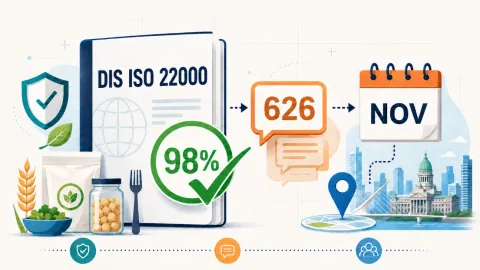
ISO 22000 Draft Approved With 98% Support, Comments Review Set for November
The revision of ISO 22000, the international standard for food safety management systems, has cleared its Draft International Standard (DIS) ballot with 98% positive votes.
ISO Approves Blockchain-as-a-Service Standard Project
The International Organization for Standardization (ISO) has approved ISO 25904, a new standard project to establish a common technical framework and functional requirements for Blockchain-as-a-Service (BaaS) platforms.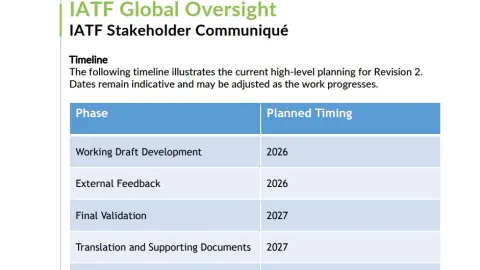
IATF 16949 Second Edition Expected in Mid-2027 With Five Priorities Set
IATF 16949 is expected to reach its second edition in mid-2027, with five priorities set for the revision.
GHG Protocol Aligns Scope 2 and AMI Development for Future Joint ISO Standard
The Greenhouse Gas Protocol (GHG Protocol) the results of its public consultation on the update to its Scope 2 Guidance and released preliminary feedback on the development of its Actions and Market Instruments (AMI) standard.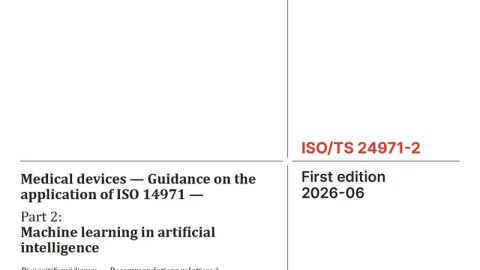
Risk Management Guidance for AI-Powered Medical Devices: First Edition of ISO/TS 24971-2 Released
ISO has released the first edition of ISO/TS 24971-2:2026, providing guidance on applying the ISO 14971 risk management process to machine learning-enabled medical devices (MLMDs).
Revised ISO 19008 Expands Cost Coding System to Lower Carbon Energy
ISO 19008 has been revised to extend its common system for organizing and comparing cost data to lower carbon energy as well as oil and gas.
GLOBALG.A.P. Farm Assurance and Social Practice Standards Set for September Update
Agraya has announced that it will publish GLOBALG.A.P. Integrated Farm Assurance (IFA) v6.1 Smart and GLOBALG.A.P. Risk Assessment on Social Practice (GRASP) v2.1 on September 1, 2026.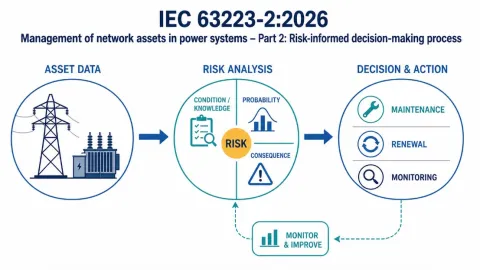
IEC 63223-2 Sets Risk-Informed Decision-Making (RIDM) Process for Power Network Assets
The International Electrotechnical Commission (IEC) has published IEC 63223-2:2026, introducing a structured risk-informed decision-making (RIDM) process for managing existing assets in power networks.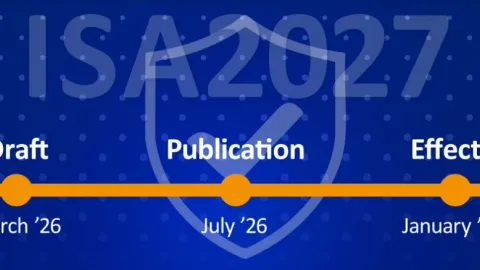
VDA Releases ISA 2027 Information Security Assessment Catalogue for TISAX
The German Association of the Automotive Industry (VDA) has published ISA 2027, the next version of the Information Security Assessment (ISA) catalogue used by TISAX, an information security assessment and exchange mechanism for the automotive industry.
Global Standards Updates Flagship GOTS Standard to Version 8.1
The Global Standards (GS) has updated the Global Organic Textile Standard (GOTS) to Version 8.1, its first revision since the major Version 8.0 release in March.
TÜV SÜD Acquires SustainCERT to Accelerate Digital Carbon Verification
Germany-based testing, inspection and certification company TÜV SÜD has acquired climate verification platform SustainCERT