
Management Systems World
All on Quality and other Standards in one place since 2010. Now Worldwide.
News IT / Telecommunication
Please note that you have to be a registered member with paid membership in order to see full articles.
Become a MemberSelected News
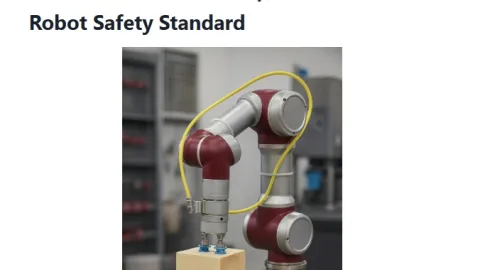
New Edition of ANSI/A3 R15.06 Reshapes Safety Rules for Industrial Robots
The Association for Advancing Automation (A3) has released the updated ANSI/A3 R15.06-2025: Industrial Robots and Robot Systems – Safety Requirements,
Public Consultation Closing for PAS 1958 on Built Environment Digitalization
A new standard aiming to unify data and information management in the built environment -
India Invites Experts to Shape Software and Systems Engineering Standards
The Electronics and IT Department of the Bureau of Indian Standards (BIS) is calling for
Dekra First in Netherlands Accredited for IEC 62443 Cybersecurity Testing
DEKRA Certification B.V. has become the first organization in the Netherlands to be
TYC Achieves TISAX Certification for Automotive Information Security
TYC Brother Industrial Co. Ltd., a Taiwanese manufacturer of automotive lighting and other vehicle parts,has officially obtained certification under
MHM Becomes First SCC-Accredited Body for AI Management Systems
MHM Advisory Ltd. has become the first certification body accredited under the Standards Council of Canada (SCC) AI Management Systems (AIMS) Accreditation Program.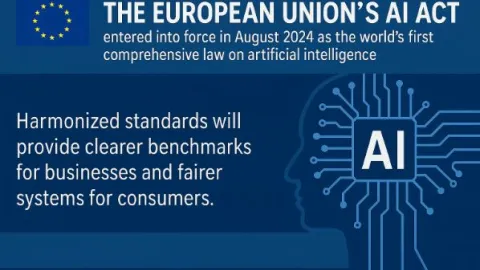
With EU AI Act in Force, Standards Are Set to Drive Implementation
The European Union’s AI Act, which entered into force in August 2024 as the world’s first comprehensive law on artificial intelligence,
Vietnam Institutions Urged to Adopt ISO 27001 Cybersecurity Standard After Recent Breach
A data breach at the National Credit Information Center of Vietnam (CIC) has prompted the Vietnam Cyber Emergency Response Center (VNCERT) to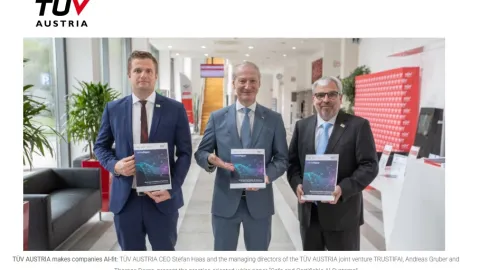
TÜV Austria White Paper Details Trusted AI Framework for Safe and Certifiable Systems
TÜV Austria has released a new white paper presenting its Trusted AI Framework, a structured approach for evaluating and certifying artificial intelligence (AI) systems in safety-critical applications.
Jardine Engineering Secures ISO 19650 BIM Certification for Digital Construction
The Jardine Engineering Corporation Limited (JEC) has become one of Hong Kong’s first engineering services providers to achieve certification to ISO 19650-1:2018 and ISO 19650-2:2018,
UKAS Moves Forward With Accreditation for AI Management Systems
The United Kingdom Accreditation Service (UKAS) is advancing its work on accreditation for Artificial Intelligence Management Systems (AIMS),