Management Systems World
All on Quality and other Standards in one place since 2010. Now Worldwide.
Please note that you have to be a registered member with paid membership in order to see full articles.
Register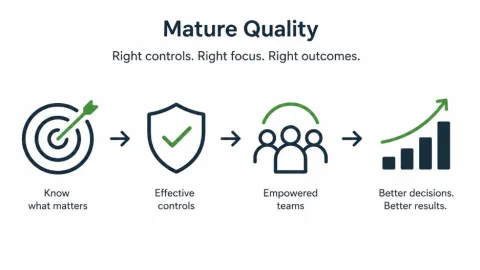
Reaching Quality Maturity Requires Simpler, More Effective Systems
Many quality systems become heavier over time, but maturity comes from making them work better, not adding more layers.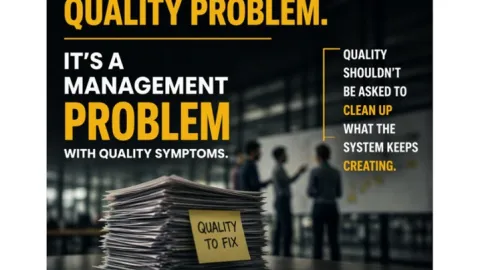
Quality Issues As Symptoms Of Weak Management Systems
What is often described as a quality issue may instead point to a weakness in how the organization is managed.
Audit Theater Wastes Time And Hides Real Problems
Companies often stage their systems before audits instead of showing how they actually work.
Firefighting Signals Missing Alignment Even In ISO Certified Systems
Organizations can remain stuck in constant firefighting despite ISO certification, pointing to a lack of alignment between systems and daily work.
Switching to eQMS Without Stable Processes Can Backfire
Thinking of switching to an eQMS to fix quality problems?
Growing Bureaucracy Obscures Original Purpose of Management System Standards
As layers of requirements grow, audit results are becoming less consistent across organizations and markets, moving standards away from their original purpose.
From Day 1 to Day 100, Quality Manager Reality Sets In
Expectations of a quality role can shift sharply within the first 100 days, as early confidence gives way to the realities of how organizations actually operate.
Quality Work Would Be Easier If Schools Taught These Real-Life Skills
Quality professionals often deal with problems that start long before people enter the workplace.
Certifying Large Companies Requires A Different Approach
A question raised by Kyle Chambers during a podcast prompted Michael Mills to explain how large, complex organizations can be certified to standards like ISO 9001, pointing to the need to carefully define the scope of certification.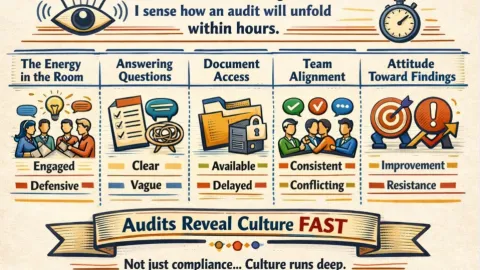
Five Early Signs That Reveal How a QA Audit Will Unfold
Early signs can show how a QA audit will unfold, and experienced auditors know how to read them.
Does AI Improve Auditor Judgment Or Create New Blind Spots In Food Safety?
AI is already reshaping food safety and quality audits, but the key issue is whether it improves how auditors see risk or creates new blind spots.
Too Messy Or Just More Useful? Rethinking QM Documentation Formats
Stephan Joseph, founder of Joseph Beratung, challenges a familiar concern in an opinion piece:
Thinking Like An Auditor Starts With Questions Not Checklists
Carlos Manuel Pereira da Cruz, a consultant, auditor, trainer, author, and ISO 9001 expert, explains in a video lesson that effective audits begin with the right questions rather than clauses or checklists.
Why Quality Fails in Manufacturing Despite More Inspection And Supervision
Focusing on inspection instead of preventing problems before they occur allows defects to keep coming back in manufacturing,
Systems, Not People, Determine Results: Deming’s Red Bead Lesson Still Ignored
Most performance problems come from the system that produces results, not from the people working within it,
When Written Procedures Do Not Match Daily Work, Certified Systems Fail
Many companies obtain ISO certification expecting business benefits, but real-world experience shows that written procedures often do not match daily work, limiting the value of the system.
Quality Managers, Stop Absorbing Dysfunction And Reclaim Your Role
Many quality managers stay too long in environments that do not support strong quality practices, gradually adapting to issues they should be challenging.
Mentoring Could Solve The Auditor Pipeline Problem
The ISO auditing field faces a growing talent pipeline problem as demand for certification rises while fewer new auditors enter the profession.
Building Expertise in Food Safety Standards: An Auditor’s Career Journey
Cemal Gurkan Kara, Chief Strategy Officer at AGFOCERT, shares how he built his expertise in food auditing across different standards, countries, and challenges as his career developed.
AI Is Not Just A Tool As It Redefines The Role Of Quality
AI is no longer just a support tool in quality work, as it begins to redefine which tasks matter and what roles are built around.
What U.S. Food Safety Actions Mean For Latin America Exporters
Recent actions by the FDA and USDA FSIS are shaping how companies in Latin America exporting to the U.S. approach food safety.
As Geopolitical Risks Rise, ISO 28000 and CTPAT Support Supply Chain Security Governance
Rising tensions in the Middle East are increasing global supply chain risks, exposing vulnerabilities in energy supply, shipping routes, and cross-border trade,
How CASCO Toolbox Helps Structure Global Conformity Assessment
The CASCO toolbox is a set of international standards and guides that regulators use to structure conformity assessment across sectors, covering activities such as testing, inspection, and certification.