Management Systems World
All on Quality and other Standards in one place since 2010. Now Worldwide.
News IT / Telecommunication
Please note that you have to be a registered member with paid membership in order to see full articles.
RegisterSelected News
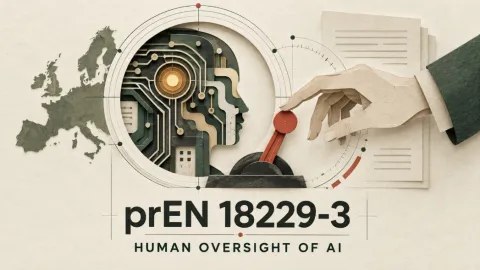
EN 18229-3 Human Oversight, Part of AI Trustworthiness Framework, Opens for Comment
A draft on human oversight is now open for comment within the five-part European EN 18229 AI trustworthiness framework.
NEN Launches Customer Panel to Shape AI Tools for Standards
The Royal Netherlands Standardization Institute (NEN) has launched an AI customer panel to help shape tools that make standards easier to find, understand and use while reducing the risk of incorrect answers from general-purpose AI systems.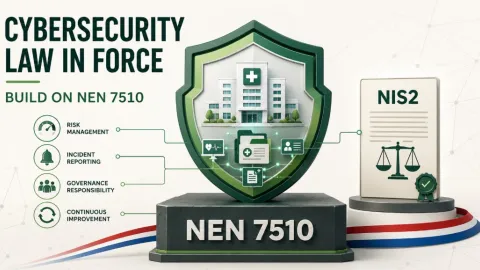
How NEN 7510 Provides a Starting Point for New Cybersecurity Act Requirements
With the Dutch Cybersecurity Act (Cbw) now in force, healthcare organizations already using NEN 7510 can use their existing risk assessments, security measures as a starting point for addressing the new requirements.
Serbia’s Innovation Fund Offers MSMEs Up to RSD 3.6 Million in AI Vouchers
The Innovation Fund of the Republic of Serbia (IF) is offering eligible micro, small and medium-sized enterprises (MSMEs) up to RSD 3.6 million in AI vouchers to introduce or expand the use of artificial intelligence in their business.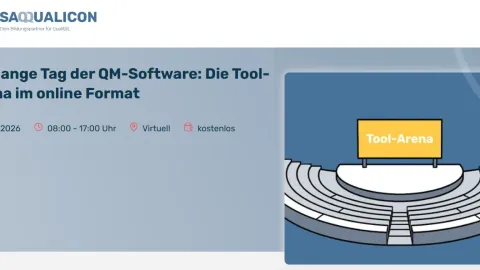
Ten QM Software Providers to Present Their Tools at SAQ-QUALICON Event
SAQ-QUALICON is organizing a free online Tool Arena on December 10, 2026, where 10 providers will present their own quality management software.
Türkiye Sets Coordinated Transition Timeline for ISO/IEC 27701 and ISO/IEC 27706
The Turkish Accreditation Agency (TÜRKAK) has outlined how accredited certification bodies and their clients must transition to the updated standards for privacy information management certification.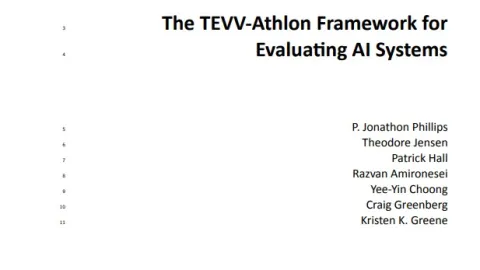
NIST Seeks Comments on Customizable AI Evaluation Framework
The National Institute of Standards and Technology (NIST) has released an initial draft of NIST AI 200-2, The TEVV-Athlon Framework for Evaluating AI Systems, and is seeking comments through October 6, 2026.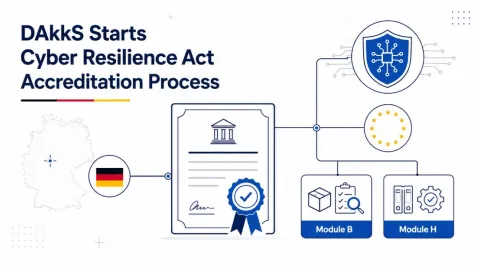
DAkkS Starts Cyber Resilience Act Accreditation Process
Germany’s national accreditation body, Deutsche Akkreditierungsstelle (DAkkS), has opened accreditation applications for conformity assessment bodies that want to work under the EU Cyber Resilience Act (CRA).
NIST Opens AI Documentation Draft for Public Comment
The National Institute of Standards and Technology (NIST) is seeking public comment through September 16 on proposed guidance and templates for documenting AI datasets and models, which it plans to put forward for possible development as an international standard.
South Korea to Lead New ISO Drone Cybersecurity Working Group
South Korea will lead a newly established International Organization for Standardization (ISO) working group on drone cybersecurity, which will oversee the development of international standards in the field.
Czech Republic Adds Construction-Stage Requirements to BIM Data Standard
The Czech Standardization Agency (ČAS) has added construction-stage requirements to the country’s Construction Data Standard (DSS), specifying what information digital building models used in Building Information Modeling (BIM) must contain while a project is being built.
EN 18286 Published to Help Organizations Prepare for the EU AI Act
CEN and CENELEC have published EN 18286, a new European standard that provides a quality management framework toGlobal News
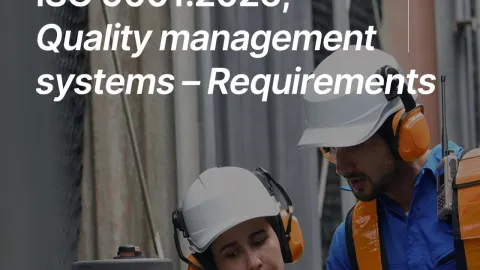
ISO 9001:2026 Officially Launched
The sixth edition of ISO 9001, the world’s most widely used quality management system standard, has been officially launched by ISO during a virtual press conference.
Global Responsible Textile Standard (GRTS) Launches for Certification of Wider Range of Fibers
Global Standards has launched the Global Responsible Textile Standard (GRTS), a new certification standard for textiles made from a wider range of plant, animal, synthetic, man-made cellulosic and recycled fibers.
ISO 45001 Second Edition Clears DIS Ballot With Overwhelming Support
The draft second edition of ISO 45001 has passed its Draft International Standard (DIS) vote with only one vote against, moving the revision closer to its planned publication in the first half of 2027.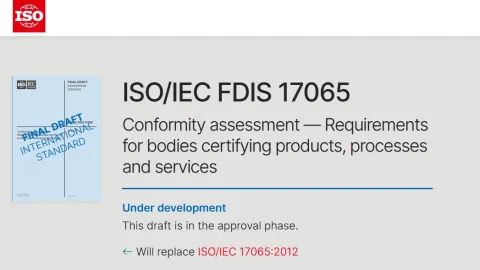
Second Edition of ISO/IEC 17065 Reaches Final Approval Phase
The second edition of ISO/IEC 17065, which sets requirements for bodies that certify products, processes and services, has moved further into the final approval process and is now at stage 50.20 of the Final Draft International Standard (FDIS) phase.
SMART Initiative Enters Pilot Phase in October, Testing Nine Standards
A pilot of the ISO and IEC SMART standards initiative will begin in October, testing nine selected international standards.
New Net Zero Carbon Cities Standard Project Approved as ISO 37115-2
The International Organization for Standardization (ISO) has approved a proposal for ISO 37115-2, a new standard that will set out principles and fundamentals for net zero carbon cities.
First Edition of ISO 41002 Guides Development of Facility Management Organizations
The first edition of ISO 41002 gives organizations guidance on how to develop and structure their facility management function across strategic, tactical and operational levels.
ISO/DTS 5112 Road Vehicle Cybersecurity Audit Guidance Reaches Final Approval Stage
ISO/DTS 5112, the draft Technical Specification for auditing cybersecurity management systems (CSMS) across the automotive supply chain, has reached the final approval stage.
ISO 37011 Webinars on Purpose-Driven Organizations Set for September 22 and 23
Two international webinars on ISO 37011, the draft guidance standard for purpose-driven organizations, will be held on September 22 and 23 ahead of consultation on the draft beginning September 24, 2026.
ISO 45010 Becomes First International Standard on Menstruation and Menopause at Work
ISO has published ISO 45010, the first International Standard focused on supporting employees experiencing menstruation and menopause at work.
Digital Identity Standards Now Freely Accessible Worldwide
Key ISO and IEC digital identity standards, including the ISO/IEC 18013 and ISO/IEC 23220 series, are now freely accessible worldwide through a new sponsorship model set up by the German Institute for Standardization (DIN) and the OpenWallet Foundation (OWF).